The very word “West” in American history has all sorts of different connotations; from cowboys and Indians to dust bowls and Davy Crockett, the American West is as diverse as it is expansive.
The drive that led the Founding Fathers, and particular Thomas Jefferson, to seek agreements that would allow American soil to stretch from sea to sea, is one that shaped and shook the very foundations of the republic.
American progress has been defined by the Manifest Destiny, a 19th century belief that the growth of the American nation to encompass the entirety of the Americas was inevitable—but it also presented many challenges.
Recommended Reading
The American Revolution: The Dates, Causes, and Timeline in the Fight for Independence
Louisiana Purchase: Date, Cost, Importance, and Results

US History Timeline: The Dates of America’s Journey
But to understand the true story of westward expansion in the United States, one must go back far earlier than just Thomas Jefferson’s talk of Manifest Destiny, and, in fact, even early than the formation of the United States, with the 1783 Treaty of Paris.
This treaty, with Great Britain, make apparent the first parameters of the United States, which stretched from the Eastern seaboard to the Mississippi River at the end of the Revolutionary War. After the defeat at Yorktown in 1781, the British hope to remain controller of the American colonies was futile, however, it was two more years until peace was attempted.
The thirteen original colonies, which were at war against the British crown, were allied with France, Spain, and Holland, and the national interests of these foreign countries further complicated American’s desire for independence.
With John Adams, John Jay, and Benjamin Franklin as national envoys to Britain, the treaty solidified the independence of the American colonies and recognized the United States of America as an independent nation.
But more than that, it established the new country’s boundaries to the west, south, and north; the newly formed country would stretch from the Atlantic to the Mississippi river, the Florida border to the south, and the Great Lakes and Canadian border to the north, giving the country a significant amount of land that had not originally been a part of the thirteen colonies.
These were new lands that many states, including New York and North Carolina, tried to claim, when the Treaty almost doubled the American territories.
Where Manifest Destiny ties into the progression of the country is here: the ideologies and discussions of the time. During the time, talk of the expansion of freedoms of commerce, society, and intellectualism of the newly minted American country were fiercely involved in the politics and policies of the late 18th, and early 19th century.
Thomas Jefferson, who was the president at the time of the Louisiana Purchase, used Manifest Destiny in his correspondence to convey the belief of America’s need, and right, to continue it’s country borders outward.
After the expansion of the 13th original colonies during the Treaty of Paris, the country took heart in it’s need for growth and continued its pursuit west.
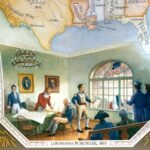
When, in 1802, France prohibited U.S. merchants from conducting commerce in the port of New Orleans, President Thomas Jefferson sent an American envoy to discuss the alteration of the original treaty.
James Monroe was that envoy, and with the help of Robert Livingston, the American minister to France, they planned to negotiate a deal that would allow for the United States to purchase territory from the French—originally a section as small as half of New Orleans—to allow Americans to set up commerce and trade in the Louisiana port.
However, once Monroe arrived in Paris, the French were on the brink of another war with Britain, losing ground in the Dominican Republic (then the island of Hispaniola) due to a slave uprising, and were suffering from a lack of resources and troops.
With these other factors plaguing the French government, they made Monroe and Livingston an amazing offer: 828,000 miles of the Louisiana Territory for $15 million dollars.
With Jefferson at mind to expand to the Pacific, the US government jumped at the offer and finalized the deal on April 30, 1803. Once again, the size of the country was doubled, and cost the government roughly 4 cents an acre.
The thirteen original colonies, along with the Louisiana, Dakotas, Missouri, Colorado, and Nebraska territories, expanded outward, with the new parameters extending all the way to the natural line of the Rockies, and with it the hopes and dreams of a free, farmed, and commercially viable American West continued.
One of the positive outcomes that followed the Louisiana Purchase was that of the expeditions of Lewis and Clark: the first American explorers out West. Commissioned by President Jefferson in 1803, a group of select U.S. Army volunteers under the direction of Captain Merriweather Lewis and his friend, Second Lieutenant William Clark, embarked from St. Louis and ultimately crossed the American West to arrive at the Pacific Coast.
The expedition was discharged to map the newly added American territories and find useful trails and routes throughout the western half of the continent, with additional need for dominance in the area before Britain or other European powers set in, scientific study of plant and animal species and geography, and the economic opportunities available for the young country out west through trade with the local Native populations.
Their expedition was successful in the mapping of lands and establishing some claim over the lands, but it was also very successful in the creation of diplomatic relations with some 24 indigenous tribes of the area.
With journals of indigenous plants, herbs, and animals species, as well as detailed notes of the natural habitats and topography of the west, Jefferson reported the duo’s findings to Congress two months after their return, introducing Indian corn to the diets of Americans, the knowledge of some hitherto unknown tribes, and many botanical and zoological findings that created an avenue for further trade, exploration, and discoveries for the new nation.
However, for the most part, the six decades that followed the purchase of the Louisiana territories were not idyllic. Some years after the Louisiana Purchase, the Americans were once again embroiled in a war with Britain—this time, it was the war of 1812.
Begun over trade sanctions and restrictions, the British enticement of Native American hostility against western bound American settlers, and the American desire to continue expanding westward, the United States declared war on Britain.
The battles were conducted over three theatres: Land and sea on the American-Canadian border, a British blockade on the Atlantic coast, and in both the Southern United States and the Gulf Coast. With Britain tied up in the Napoleonic Wars on the Continent, the defences against the US were primarily defensive during the first two years of the war.
Later, when Britain could devote more troops, the skirmishes were tiresome, and eventually a treaty was signed in December of 1814 (although the war continued into January of 1815, with one remaining battle in New Orleans who didn’t hear of the treaty being signed).
The Treaty of Ghent was successful at the time, but let to the United States signing again at the Convention of 1818, again with Great Britain, over some unsettled issues with the Treaty of Ghent.
This new treaty stated explicitly that Britain and America would occupy the Oregon territories, but the United States would acquire the area known as the Red River Basin, which would eventually become included in the state territories of Minnesota and North Dakota.
In 1819, the American borders were reorganized again, this time as a result of adding Florida to the union. After the American Revolution, Spain acquired all of Florida, which prior to the Revolution, was held jointly by Spain, Britain, and France.
This border with Spanish territory and the new America caused many disputes in the post-Revolutionary War years due to the territory acting as a runaway slave haven, a place where Native Americans moved freely, and also a place where American settlers relocated and rebelled against the local Spanish authority, which was sometimes supported by the US government.
With the various wars and skirmishes of the new state in 1814 and again between 1817-1818, Andrew Jackson (prior to his presidential years) invaded the area with American forces to defeat and remove several native populations even though they were under the care and jurisdiction of the Spanish crown.
With neither the American nor the Spanish government wanting another war, the two countries came to an agreement in 1918 with the Adam-Onis Treaty, which, named after Secretary of State John Quincy Adams and Spanish foreign minister Louis de Onis, moved authority over the Floridian lands from Spain to the US in exchange for $5 million and to relinquish any claim on the Texan territory.
Though this expansion was not necessarily West, the acquisition of Florida proceeded many events: the debate between free and slave states and the right to Texas territory.
In the events that led up to the Texas Annexation in 1845, the next great land aquisition of the US, the twenty-five years before that presented many conflicts and problems for the American government. In 1840, forty percent of Americans–roughly 7 million–lived in the area known as the trans-Appalachian West, going out west to pursue economic opportunity.
These early pioneers were Americans that took Thomas Jefferson’s idea of freedom, which included farming and landownership as the starting level of a flourishing democracy, to heart.
In America, versus the social makeup of Europe and it’s constant working class, a burgeoning middle class and its ideology flourished. However, this early success was not to last uncontested, while the questions of whether or not slavery should be legal throughout the westerns states became a constant conversation surrounding the acquisition of new lands.
Just two years after the Adam-Onis Treaty, the Missouri Compromise entered on the political stage; with the admittance of Maine and Missouri into the union, it balanced one as a slave state (Missouri) and one a free state (Maine).
Latest US History Articles

Who Invented the Assembly Line? Henry Ford and the History of the Assembly Line
Who Invented the Cotton Gin? Eli Whitney and Cotton Gin Impact on America
The Most Famous Outlaws of the Wild West: Jesse James to Robert Leroy Parker
This compromise maintained the balance of the Senate, which was very concerned about not having too many slave states, or too many free states, to control the balance of power in Congress. It also proclaimed that slavery would be illegal north of the Southern boundary of Missouri, throughout the entire Louisiana Purchase. While this lasted for the time being, it wasn’t a permanent solution to the growing questions of land, economy, and slavery.
While “King Cotton” and it’s increasing power on the global economy demanded more land, more slaves, and generated more money, the Southern economy grew in power and the country became more dependent on slavery as an institution.
READ MORE: Who Invented the Cotton Gin? Eli Whitney and Cotton Gin Impact on America
After the Missouri Compromise was made law, Americans continued to move westward, with thousands migrating across into Oregon, and the British territories. Many more also moved into the Mexican territories that are now California, New Mexico, and Texas.
While the first settlers of the west had been the Spanish, including the territory of Texas, the Spanish crown had dwindling resources and power in the 19th century, and with the slow-down of their land-hungry empire, Spain allowed many Americans into their borders, particularly in Texas. In 1821, Moses Austin was granted the right to bring some 300 Americans and their families for settlement in Texas.
However, despite Congress being majority pro-slavery, many Northerners and would-be Westerners rejected the idea of slavery as an inhibition on their own successes as farmers and landowners. This undercurrent of frustration would continue throughout the country’s discussions until the Civil War.
With his death, Moses’ son Stephen Austin took control of the settlement and sought permission for their continued rights from the newly independent Mexican government. 14 years later, some 24,000 people, including slaves, had migrated into the territory despite attempts by the Mexican government to halt the influx of settlers.
In 1835, those Americans who had migrated to Texas teamed with their neighbors of Spanish descent, known as Tejanos, broke into fighting outright with the Mexican government for, what they felt like, was a limit on the admission of slaves into the area and direct violations of the Mexican constitution.
One year later the Americans stated Texas as an independent slave state, called the Republic of Texas. One battle in particular, the Battle of San Jacinto, was a deciding factor for the skirmish between countries, and the Texans ultimately won their independence from Mexico and petitioned to join the United States as a slave state.
It’s voluntary admission to the United States and annexation happened in 1845, following a decade of shaky independence for the Republic due to constant threat from Mexican governments and a treasury that couldn’t fully support the state.
As the state was annexed, an almost immediate war broke out between the US and Mexico to decide the limits of the new state of Texas, which included pieces of modern-day Colorado, Wyoming, Kansas, and New Mexico, and the western boundaries of America.
Later in June of the same year, negotiations with Great Britain yielded more land: Oregon joined the union as a free state. The land occupied ended at the 49th parallel and included pieces of what is now known as Oregon, Washington, Idaho, Montana, and Wyoming. At last, America stretched across the continent and reached the Pacific.
While successful, the American-Mexican War was relatively unpopular, with the majority of free men viewing the entire ordeal as an attempt to extend the reach of slavery, and undermine the individual farmer in his attempt to enter the commercial realm of the American economy.
In 1846, one congressman from Pennsylvania, David Wilmot, attempted to halt the progression of what was known in contemporary times as a “slavocracy” into the west by attaching a provision to a bill on war appropriations stating that no slavery be allowed in any of the lands acquired from Mexico.
His attempts were unsuccessful and was not passed in Congress, highlighting how very troubled, and divisive, the country was becoming on the subject of slavery.
In 1848, when the Treaty of Guadelupe Hidalgo ended the Mexican War and added some one million acres to the US, the question of slavery and the Missouri Compromise was once again on the national stage.
The fighting that had continued for more than a year and ended in September of 1847, resulted in a treaty that recognized Texas as a U.S. state, and also took much of what was considered Mexican territory, for the price of $15 million and a boundary that extended to the Rio Grande river to the south.
The Mexican cession included the land that would later become Arizona, New Mexico, California, Nevada, Utah, and Wyoming. It welcomed Mexicans as US citizens who decided to stay in the territory, but later stripped them of their territory in favor of American business men, ranchers, railroad companies, and the United States Department of Agriculture and Interior.
READ MORE: Who Invented the Railroad? Exploring the Fascinating History of Railroads
The Compromise of 1850 was the next treaty to tackle the problem of slavery in the west, with Henry Clay, a Senator from Kentucky, proposing another (futile) compromise to create a peace that would be enacted Congress and would maintain the balance of slave and non-slave states.
The treaty was split into four main declarations: California would enter the Union as a slave state, Mexican territories would be neither slave nor non-slave and would allow the occupants to decide on which they would prefer to be, the slave trade would become illegal in Washington, D.C., and the Fugitive Slave Act would be introduced and would allow Southerners to track and capture runaway slaves that had escaped to Northern territories where slavery was illegal.
Though the compromise was passed, it presented as many problems as it settled, including the horrifying ramifications of the Fugitive Slave Act and the fight known as Bleeding Kansas.
In 1854, Stephen Douglas, an Illinois senator, presented the inclusion of two new states, Nebraska and Kansas, into the union. Within regards to the Missouri Compromise, the two territories were by law required to be admitted into the union as free states.
However, the power of the Southern economy and politicians did not allow the addition of any free states to outnumber their slave states, and Douglas proposed instead that the state citizens be allowed to choose as to whether the states would allow slavery, calling it “popular sovereignty.”
The Northern states were enraged by Douglas’s lack of backbone, and the battles for the states of Kansas and Nebraska became an all-encompassing preoccupation of the nation, with emigrants both from Northern and Southern states moving to influence the vote.
With the influx of people in 1845 and 1855 to throw the election in their own favor, Kansas became ground for a civil war.
Some hundreds of people died in what was known as Bleeding Kansas, and the argument resurfaced on a larger scale, that of the entire national stage, ten years later. As Jefferson predicted, it was the freedom of the west, and that for America’s slaves, that proved to define the freedom of the west.
The last major land acquisition in the American West was that of the Gadsden Purchase, in 1853. With the vague details of the Treaty of Guadelupe Hidalgo, there were some border disputes hanging in the mix and creating tension between the two countries.
With plans to build railroads and connect the eastern and western shores of America, the disputed territory surrounding the southern area of the Gila River became a plan for America to finally finish it’s border negotiations.
In 1853, then-President Franklin Pierce employed James Gadsden, the president of the South Carolina Railroad and former militia member who was responsible for the removal of the Seminole Indians in Florida, to negotiate with Mexico over the land.
With the Mexican government in desperate need of money, the small strip was sold to the US for $10 million. After the conclusion of the Civil War, the Southern Pacific Railroad finished its route into California by crossing into the territory.
Explore More US History Articles
Royal Proclamation of 1763: Definition, Line, and Map

Where Does Chocolate Come From? The History of Chocolate and Chocolate Bars
The Evolution, Growth, and History of Human Rights
The American Revolution: The Dates, Causes, and Timeline in the Fight for Independence
California Name Origin: Why Was California Named After A Black Queen?
The American Civil War: Dates, Causes, and People
It would be many years before the first transcontinental railroad would unite the seaboards of America, but it’s eventual construction, begun just before the American Civil War in 1863, would provide fast, cheap travel throughout the country, and prove to be incredibly successful from a commercial perspective.
But before the railroads could unite the country, the Civil War would rage throughout the newly acquired lands and threaten to tear apart the new nation—one whose treaty proclamations, that stated the great country stretched from Atlantic to Pacific, had barely begun to dry.
READ MORE: The XYZ Affair