With modern-day smartphone technology giving us the ability to make a high-quality movie almost instantly, it’s hard to believe there was a time before making a film was simple, cheap, and easy.
In fact, for many years, the most engaging motion pictures of the past were the stories told by your parents and grandparents and, later on, crackling audio scratched from a large vinyl disk and projected from a wooden box. Pretty primitive stuff.
But this all changed thanks to the work of one man: Eadweard Muybridge.
His experimentations and endeavors, often funded by generous benefactors, reshaped the possibilities of society and paved the way for what we now consider staples of modern life: easily accessible and digestible visual content.
Table of Contents
The First Movie Ever Made and Its Release Date
The first movie ever made was an 11-frame clip shot on June 19th, 1878, using twelve separate cameras (frame 12 was not used) to film a man riding a horse on Leland Stanford’s (the founder of Stanford University) Palo Alto Stock Farm (the eventual site of Stanford University).
Not exactly the high-action, special effects-driven, Braveheart-style, Hollywood blockbusters that grace our cinema screens today, but pretty impressive considering no one ever, in the history of the entire world, had made a movie before.
The man we have to thank for this 11-frame cinematic first is Eadweard Muybridge.
He was born Edward James Muggeridge on April 4th, 1830, in England, and for some unknown reason, later changed his name to the far harder-to-spell Eadweard James Muybridge. During his twenties, he traveled across America selling books and photographs before a serious head injury he suffered in a stagecoach accident in Texas in 1860 forced him back to England for rest and recovery.
There, he married 21-year-old Flora Shallcross Stone and fathered a child. Upon discovering letters between her and a local drama critic, Major Harry Larkyns, discussing the fact that Larkyns may have fathered Muybridge’s 7-month-old son, he shot Larkyns point-blank, killed him, and was arrested that night without protest.
At his trial, he pleaded insanity on the grounds that his head injury had dramatically altered his personality but undercut this plea by his own insistence that his actions were deliberate and premeditated.
The jury dismissed his insanity plea, but he was eventually acquitted on the grounds of justifiable homicide. It turns out that in the 1900s, it’s completely OK to kill your wife’s alleged lover in a rage of passion.
The Horse in Motion (1878)
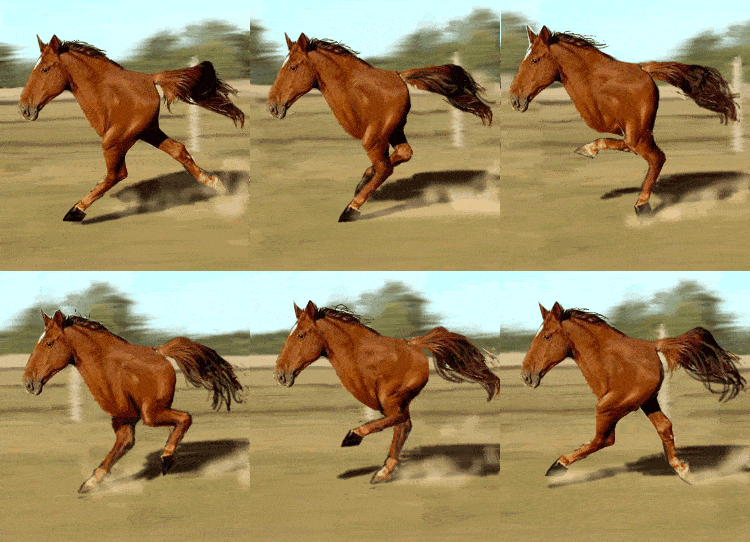
In 1872, one of the main barroom debates revolved around this question: when a horse is trotting or galloping, are all four of the horse’s feet off the ground at the same time?
The answer to this question is plainly obvious to anyone who has ever seen slow-motion footage of a horse in full flight, but it’s much harder to be certain when the animal is moving at full speed.
Exhibit A:
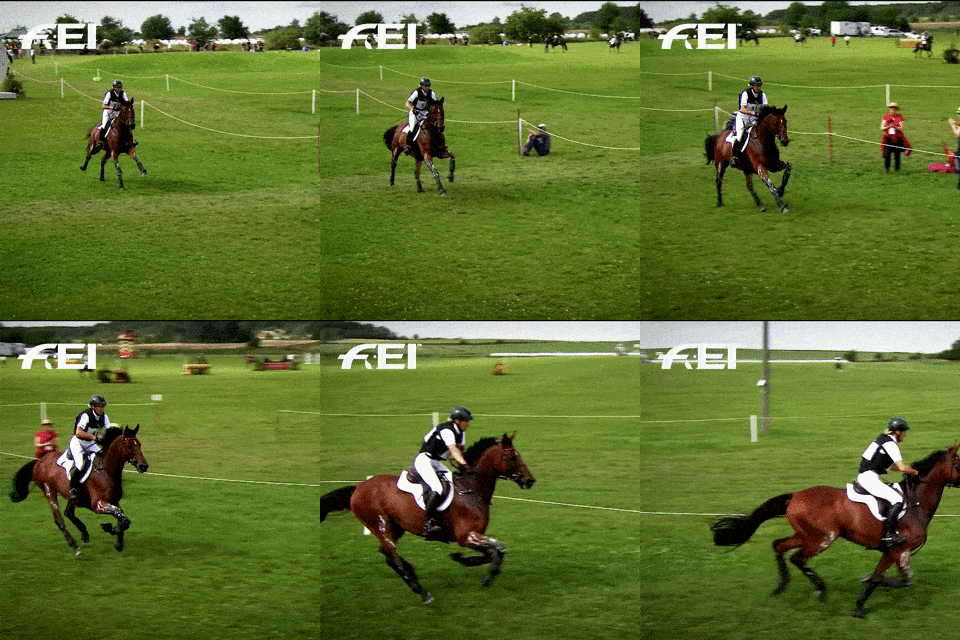
Exhibit B:
In 1872, the then-governer of California, racehorse owner, and eventual founder of Stanford University, Leland Stanford, decided to settle the debate once and for all.
He reached out to Muybridge, who at that time was a famous photographer, and offered him $2,000 to prove conclusively whether a horse ever engaged in ‘unsupported transit‘.
Muybridge provided conclusive proof of what we now take as common knowledge in 1872 when he produced a single photographic frame of Stanford’s horse “Occident” trotting with all four feet off the ground.
This initial experiment spurred Muybridge’s interest to capture a sequence of images of a horse in full gallop, but the photographic technology of the time was inadequate for such an endeavor.
Most photo exposures took between 15 seconds and a minute (meaning the subject had to remain still for that entire time) making them completely unsuited for capturing an animal running at full speed. Also, automatic shutter technology was in its very early infancy, making it unreliable and expensive.
He spent the next six years (partly interrupted by his murder trial) and spent over $50,000 of Stanford’s money (more than $1 million in today’s money) improving both camera shutter speeds and the film emulsions, eventually bringing the camera shutter speed down to 1/25 of a second.
On June 15th, 1878, he placed 12 large glass-plate cameras in a line at Stanford’s Palo Alto Stock Farm (now the Stanford University campus), set up a sheet in the background to reflect as much light as possible, and rigged them with a cord to fire sequentially as the horse passed.
The results are the 11 frames of the very first movie ever made (the 12th frame was not used in the final movie).
But, having 11 frames shot in sequence doesn’t make a movie.
To make a movie, the frames need to be viewed consecutively at high speed. This is a simple feat to accomplish today, but no device capable of presenting these images existed in 1878, so Muybridge created one.
In 1879, Muybridge devised a way to view his famous galloping horse images in sequence at high speed. It consisted of a circular metal housing with slots that held 16-inch glass disks. The housing was cranked in a circular motion by hand, and the images from the glass disks would be projected onto a screen just like this:
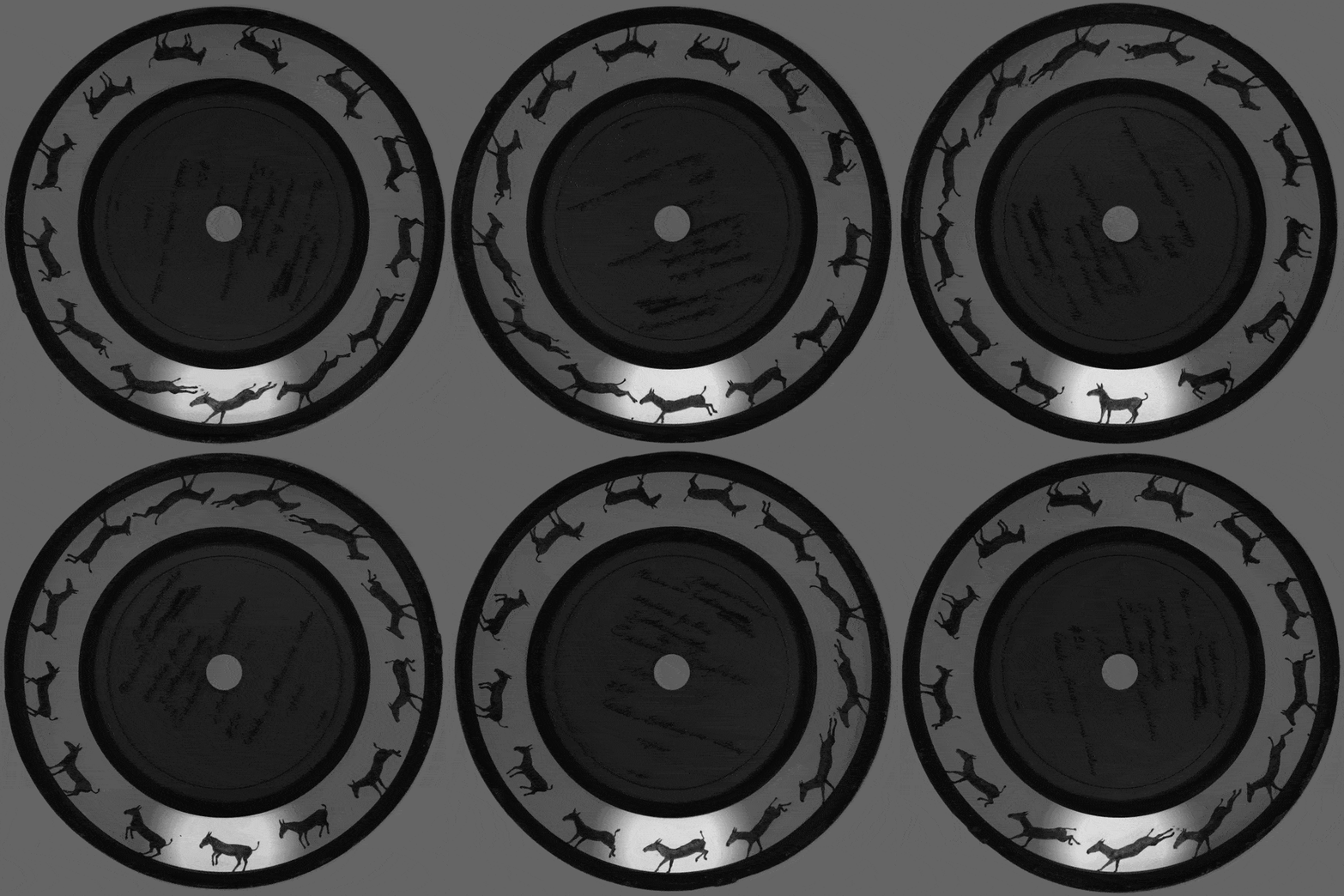
This was initially named a Zoographiscope and zoogyroscope but eventually became the zoöpraxiscope.
Roundhay Garden Scene (1888)
The first motion picture ever shot was Roundhay Garden Scene, shot in 1888. Louis Le Prince dazzles the eye with a remarkable display of 4 people walking in a garden, creating this 2.11-second cinematic masterpiece.
Arrival of a Train (1895)
In 1895, the Lumière Brothers propelled film into the future with their short film, “Arrival of a Train at La Ciotat Station.” This film stunned early audiences with its simple yet powerful depiction of a train coming towards the camera. Unlike earlier films that focused on static scenes or controlled environments, “Arrival of a Train” showcased the film’s ability to capture life in motion, bringing the dynamism of the real world onto the silver screen.
This film is often cited as one of the first movies to demonstrate the narrative filmmaking potential of cinema, moving beyond novelty and toward storytelling. The Lumière Brothers’ innovation in film shows and camera obscura techniques would influence the development of film as a modern art form, marking a critical point in film history and the journey toward narrative cinema.
Lumière Brothers: The Earliest Filmmakers and Their First Films
The Lumière brothers, Auguste and Louis, are often celebrated as pioneering figures in the film world. They played a crucial role in the birth of cinema as we know it today, holding their first film screening in 1895. This event marked the beginning of the film industry, transforming the way stories could be told and experienced.
Their contributions to film technology, including the invention of the Cinématographe, allowed them to produce and show films to a public audience, a monumental step in the development of film as an art form. The films produced by the Lumière brothers were short films showcasing everyday life, and they quickly gained popularity, showing the potential of film to captivate and entertain.
First Motion Picture
The concept of motion pictures predates the invention of the first “film” as we understand it today. Early experiments in motion pictures date back to the 19th century, with various inventors and researchers making contributions to the development of motion capture and projection technologies. However, one of the earliest recognized examples of a motion picture is the work of French inventor Louis Le Prince.
The Father of Motion Pictures
Louis Le Prince is credited with creating the world’s first motion picture in the late 1880s. He used a single-lens camera to capture moving images onto paper film. Le Prince’s experiments culminated in a short film known as “Roundhay Garden Scene,” filmed in the garden of his father-in-law’s house in Roundhay, Leeds, England, in 1888.
This short film is widely recognized as the first movie ever made, capturing a brief moment of people walking around in a garden in Roundhay, Leeds, England. Despite its duration of just over two seconds, it holds immense significance as the earliest surviving instance of the motion picture.
Shot at 12 frames per second on paper film, the Roundhay Garden Scene features four individuals: Adolphe Le Prince (Louis’s son), Sarah Whitley (Louis’s mother-in-law), Joseph Whitley (Louis’s father-in-law), and Harriet Hartley. They are seen walking in circles and laughing in the Whitley family’s garden. The simplicity of the scene belies the groundbreaking nature of the footage.
Le Prince used a single-lens camera to capture this footage, a piece of photographic equipment he had designed himself, demonstrating a significant advancement in the ability to record moving images. This invention and the film it produced were crucial in the transition from static photography to motion picture technology, setting the stage for the future film industry.
READ MORE: The First Camera Ever Made: A History of Cameras
The Oldest Full-Length Movie
The title of the oldest full-length movie is often given to “The Story of the Kelly Gang,” produced in Australia in 1906. This film is significant for several reasons, primarily because it represents a major step in the evolution of cinema from short films to feature-length narratives. With a running time of about 70 minutes, it was the first film of its length to tell a complete story, making it a key moment in film history.
“The Story of the Kelly Gang” tells the tale of the notorious Australian bushranger Ned Kelly and his gang. The film’s production demonstrated early filmmakers’ ability to weave complex narratives into longer formats, a departure from the simple scenes and brief glimpses of life that characterized the earliest films. This narrative depth signaled the medium’s potential for storytelling on a scale comparable to that of novels and theater.
Shot on location in and around Melbourne, the film used actual members of the Kelly family as consultants, adding a layer of authenticity to the portrayal. Despite its initial success and influence on the growing film industry, only fragments of “The Story of the Kelly Gang” survive today. Much of the film was lost due to the fragile nature of the nitrate film stock used at the time, as well as through the lack of proper archival preservation techniques available then.
The surviving portions of “The Story of the Kelly Gang” have been inscribed on the UNESCO Memory of the World Register.
The First Film with Sound
The first film ever created with an accompanying soundtrack was William Dickson’s test project on Thomas Edison’s latest invention – The Edison Kinetophone.
The Kinetophone was a combination of Thomas Edison’s single-viewer movie player and The Kinetoscope with his wax cylinder phonograph.
If you were one of the lucky few to witness it in late 1894 or early 1895, this is what you would have seen.
The complex plot structure, lack of true character development, and sub-standard special effects left audiences and critics unimpressed.
The obnoxiously large cone on the left-hand side of the screen was a microphone connected to a wax cylinder recorder sitting just off-screen.
The Kinetophone’s drawback of only being viewable by one person at a time, combined with advancements in projection technology making movie viewing into a group experience, resulted in the Kinetophone being superseded before it could gain widespread (or any) popularity.
The Short Film with Sound
Between 1900 and 1910, a number of significant advancements in film and sound technology were made.
The first was a number of devices that mechanically linked a film projector with a disc player to synchronize sound.
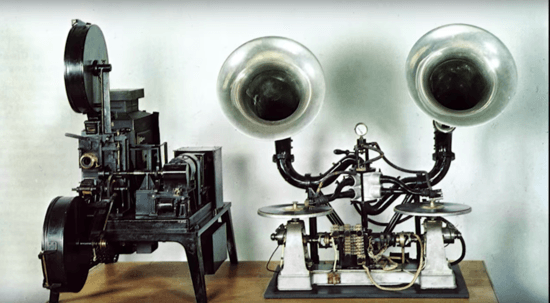
The visuals were typically captured on a machine such as a Chronograph, with sound recorded on a Chronophone. These two separate elements were then later synchronized to create the movie.
Just like the Kinetophone, these machines had significant limitations. They were extremely quiet, could only record a few minutes of audio, and if the disk jumped, the following audio would be out of sync.
These limitations prevented them from ever being used for more than short films, and they were never adopted in Hollywood.
Over the next 10 years, two major developments transformed cinema.
The Tri-Ergon Process
The first was the ‘sound on film’ or Tri Ergon process.
Invented by Engl Josef, Massolle Joseph, and Hans Vogt in 1919, it translated sound waves into electrical pulses and then into light, allowing the sounds to be hardcoded directly onto the film next to the accompanying images.
This eliminated the problem of soundtrack skipping, which produced a higher-quality product for consumers to enjoy.
The Audion Tube
The second major advancement was the development of the Audion Tube.
Originally invented by Lee De Forest in 1905, the Audion Tube allowed for the amplification of electrical signals and was used in a number of different technology applications.
He later combined this technology with a sound-on-film process of his own development, called the Phonofilm, sparking a craze in short movie production.
Nearly 1,000 short films with sound were produced in the 4 years following the Phonofilm’s development in 1920.
None of these, however, were Hollywood productions.
The Vitaphone
The Phonofilm failed to impress Hollywood, and it was never adopted by any studio. The first sound and film system to be taken seriously was the Vitaphone.
The Vitaphone was a sound-on-disk system developed by General Electric, a company that had gone into business with a relatively small studio called Warner Brothers Pictures Incorporated.
The First Hollywood Movie with Sound
Together, Warner Brothers and General Electric produced the first feature-length Hollywood film with a sound called Don Juan.
Although it doesn’t have synchronized speech, it does have synchronized sound effects and a soundtrack recorded by the New York Philharmonic Orchestra.
Despite its popularity, Don Juan failed to recoup its production costs of $790,000 (roughly $11 million in today’s money) because most theaters lacked the facilities necessary to play films with sound.
The First Film with Speech
The critical success of Don Juan convinced Warner Brothers that film with sound was the future of cinema. This was contrary to what most of the cinema industry was doing because not only was there no standardized audio system readily available to upgrade cinemas, but the actors, whilst skilled at pantomime, weren’t trained to talk in films.
The studio took on significant debt and spent nearly $3 million (more than $42 million in today’s money) rewiring all their cinemas to play audio recorded through the Vitaphone.
On top of this, in 1927, they announced that every film produced would be accompanied by a Vitaphone soundtrack.
To ensure their first film with speech was a success, they decided to adapt a popular Broadway stage show at the time, The Jazz Singer. It was the second most expensive film ever produced at the time (behind Don Juan), starring the popular actor of the time, Al Jolson.
It was originally planned as a silent film with 6 synchronized songs performed by Jolson. However, in two scenes, dialogue improvised by Jolson made it into the final cut, making The Jazz Singer the first-ever film with dialogue (commonly referred to as a ‘Talkie‘).
The audience response was overwhelming, with co-star Eugenie Besserer recalling that when they started their dialogue scene, “the audience became hysterical.“
The film became an overwhelming box-office success, taking over $3 million in ticket sales.
This was followed in 1928 by the first all-talking production on the Vitaphone, also created by Warner Brothers, called The Lights of New York.
The First Movie ever Made in Color
The development of the first color film followed a similarly complicated path to that of the first films with sound.
The First Film Presented in Colour
The first movie ever presented to the public in color wasn’t actually filmed in color.
The movie, made by W.K.L. Dickson, William Heise, and James White for Thomas Edison’s company Edison Co. in 1895, was titled Annabelle Serpentine Dance, and it was intended to be viewed through the above-discussed Edison Kinetoscope.
Bizarrely, this film has been rated more than 1,500 times on IMDB, and even more bizarrely, it’s been rated 6.4/10.
The movie was shot in black and white, with each individual frame hand-tinted after shooting, thus creating the first color movie without shooting the film in color.
The First Feature-Length Film Presented in Color
The technique of hand-tinting films quickly spread, and it wasn’t long before the first feature-length, hand-tinted film was released.
In 1903, French directors Lucien Nonguet and Ferdinand Zecca released La Vie et la Passion De Jésus Christ (The Passion and Death of Christ) with hand-tinted scenes created using the stencil-based film tinging process Pathécolor.
The Pathécolor process would continue to be used for nearly 3 decades, with the last film released using this technique in 1930.
The First Film Filmed in Color
Until the early 2000s, it was widely accepted that the first color film was those shot using the Kinemacolor System developed by George Albert Smith and launched by Charles Urban’s organization, Natural Color Kinematograph Company.
The Kinemacolor system exposed black and white film through alternating red and green filters. The camera filmed at 32 frames per second (one red and one green), which, when combined, gave them the silent film projection rate of 16 frames per second in color.
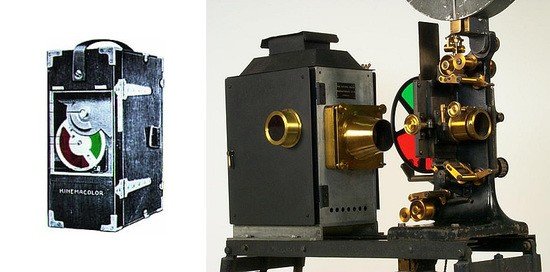
They found early success with their movie The Delhi Dubar – a two-and-a-half-hour documentary of the coronation held in Dehli of the newly crowned King George V in 1911 (India was still a British Colony at this time).
This belief was proven incorrect, however, with the discovery of Edward Turner’s color footage from ten years earlier.
His footage of London street scenes, a pet macaw, and his three children playing with a goldfish in the family’s back garden make his footage the first color footage ever shot.
He created color images by shooting each frame through three separate lenses, each with a different color filter (red, green, and blue), and combining those to create one singular color film.
The process was patented on March 22, 1899, by Edward Turner and Frederick Marshall Lee. This was actually the second color filming process patented after H. Isensee patented an earlier color filming process, but it was the first to prove effective.
Unfortunately, when Turner died in 1903, the man he passed his technology to in the hopes he could make it commercially viable, George Smith, found the system unworkable and discarded it, eventually creating Kinemacolor in 1909.
The First Two-Color Hollywood Feature
Despite its success and wide acceptance in Europe, Kinemacolor struggled to break into the US film industry. This was largely thanks to the Motion Picture Patent Company – an organization established by Thomas Edison to ensure control of the motion picture industry and force movie producers to only use the technology of MPCC members.
This created space for a new color system to become the favorite of Hollywood producers and directors – Technicolor.
The Technicolor Motion Picture Corporation was formed in Boston in 1914 by Herbert Kalmus, Daniel Comstock, and W. Burton Wescott, who drew their inspiration for their company name from the Massachusetts Institute of Technology, where Kalmus and Comstock studied.
Just like Kinemacolor, Technicolor was a two-color system, but instead of using alternating red and green filters, it used a prism inside the camera to split the incoming image into two streams filtered through both red and green lenses, which were then imprinted onto the black and white film strip simultaneously.
The first Hollywood two-color movie, titled The Gulf Between, was filmed in 1917. Unfortunately, the film was destroyed in a fire on March 25, 1961, with only small fragments of footage surviving.
Luckily, the second Hollywood feature film shot in the two-color Technicolor system survived.
The First Three-Color Hollywood Feature
The Technicolor Motion Picture Corporation continued to refine its process. They made big advancements in their two-color system (which can be seen in Mystery of the Wax Museum from 1933), and in 1932, they finally completed work on developing their three-color system.
Their three-strip system also utilized a prism to split the incoming visual stream, but this time, it was split into three streams – green, blue, and red.
The first movie released using this three-color system was a short Disney cartoon released in 1932 titled Flowers and Trees:
It wasn’t until 1934 that the first live-action, three-color Hollywood film was released.
This three-strip system would be used by Hollywood until the final Technicolor feature film was produced in 1955.
Wrapping It Up
The film industry isn’t going away any time soon. With a record of $42.5 billion in ticket sales in 2019, it’s clear that the industry as a whole is as strong as ever.
In saying that, the established players in the film production industry are facing challenges from emerging technology. The invention of the iPhone has placed cinema-quality cameras in the hands of everyday people, and with previously obscure film terms such as ‘storyboard‘ and ‘film shot list‘ becoming more and more common, the barriers to entering the film production industry are dropping dramatically.
Will they pose a threat to the established industry leaders? Only time will tell for sure. But if the pace of innovation over the last 100 years continues at the same rate, there are sure to be some shakeups.
References
https://open.lib.umn.edu/mediaandculture/chapter/8-2-the-history-of-movies
CORBETT, KEVIN J. “EMPTY SEATS: THE MISSING HISTORY OF MOVIE-WATCHING.” Journal of Film and Video, vol. 50, no. 4, 1998, pp. 34–48. JSTOR, http://www.jstor.org/stable/20688196. Accessed 1 Apr. 2024.
Phruksachart, Melissa. “THE BOURGEOIS CINEMA OF BOBA LIBERALISM.” Film Quarterly, vol. 73, no. 3, 2020, pp. 59–65. JSTOR, https://www.jstor.org/stable/48713771. Accessed 1 Apr. 2024.
Justifiable homicide?? Surely that can’t be true…
Hi Sonar, thank you for leaving input on our article. As “crazy’ as it may sound, justifiable homicide was in fact true. If you have any other questions or concerns, please let us know!
I have read your blog its really good.
I liked your post. and writing more posts like this in the future.