107.5  
Journals link Search link Partners link Information link
December, 2002
Previous
Table of Contents
Next
The American Historical Review

Table of contents
List journal issues
Home
Get a printer-friendly version of this page


The Devil in the Convent

MOSHE SLUHOVSKY


The mass demonic possession of the Ursuline nuns of Loudun in 1633–1640 is among the most famous (or infamous) episodes in the history of diabolic possession and witchcraft accusations in early modern Europe. It is nevertheless worth summarizing the events. During the night of September 22, 1632, two nuns encountered a spirit. Two days later, a large black ball traversed the refectory, pushing some nuns to the ground. The following week, a human skeleton was seen walking in the convent's corridors. Two more weeks passed before the spirit acquired the clear image of the priest Urbain Grandier, the curé of the Loudunais parish of Saint-Pierre-du-Marché, and a controversial figure in town. In the following weeks, numerous nuns were attacked and possessed by evil spirits. Some sisters heard voices, some were beaten and slapped by invisible entities, while others laughed immodestly and involuntarily. Exhibiting supernatural physical strength, screaming, crying, fainting, and suffering from uncontrollable seizures and convulsions, the sisters showed all the traditional marks of diabolic possession. According to well-established Catholic tradition, exorcism rituals were then organized by the local clergy. It was during these ceremonies that the nuns accused Grandier of having signed a pact with Satan and initiated the nuns' possession. The demons, speaking through the sisters' mouths, supported these claims and even supplied the exorcists with a signed copy of the pact between Grandier and the devil, the original of which had been signed with Grandier's own blood and was kept in Hell. Grandier had had a longstanding quarrel with the local ecclesiastical hierarchy. Once accused, and aware that he was not to get any help from his fellow Loudunais, he tried to mobilize patronage and support in Paris, but he failed there, too. Following a series of trials, he was found guilty and executed on August 18, 1634. The possessing demons then began to depart from the nuns' bodies, and the town of Loudun could have expected to calm down and regain its pleasant obscurity.


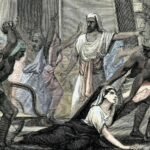
    A woodcut from 1598 shows an exorcism performed on a woman by a priest and his assistant, with a demon emerging from her mouth. In Pierre Boaistuau, et al., Histoires prodigieuses et memorables, extraictes de plusieurs fameux autheurs, Grecs, & Latins, sacrez & prophanes (Paris, 1598), vol. 1.
 

1
     But this was not to happen. Jeanne des Anges, the mother superior of the community, remained possessed by seven different demons. Repeated attempts to dispossess her failed. In fact, things went from bad to worse when the Jesuit priest Jean-Joseph Surin, who had arrived in Loudun in December 1634 to help with her exorcism, himself started experiencing visions and hallucinations, seizures, temporary paralysis, and slowly losing his verbal capabilities. It looked as if he and Jeanne des Anges were exchanging roles, and while she was slowly recovering, he was losing his mental capacity. "During my ministry, the devil passed from the body of the possessed person and entered into mine," lamented Surin to his friend, the Jesuit father Achille Doni d'Attichy.1 2
     In October 1637, the mother superior regained her health. The last departing demons left clear signs of their exit from her body, when the names Joseph and Mary miraculously appeared inscribed on des Anges's left arm. Shortly afterward, the names Jesus and F. D. Salles also appeared. The last name commemorated François de Sales, the recently deceased French saint in whose shrine in the city of Annecy Jeanne des Anges was promised, in a vision, to make a full recovery. Jeanne des Anges spent the next few years of her life traveling around France and showing the divine marks on her hands to believers, among them the royal couple and Cardinal Richelieu. She then retired to Loudun, where she spent her remaining years as a famous mystic, communicating through her guardian angel with the divine, having visions, and sending messages back and forth between the worlds.2 3
     The diabolic possessions and exorcisms in Loudun became an instant sensational drama. Detailed reports and letters were sent from the small town describing the mysterious events, and people came from all over France, and even as far as England and Italy, to witness the strange occurrences. Later on, the case played a major role in Enlightenment anticlericalism and in nineteenth-century positivist attacks on the alleged fanaticism and ignorance of the Catholic Church. The possession in Loudun is also a prominent feature in recent interpretations of both the witch craze that had swept Europe in the early modern period and of the transition from the alleged homogenous theological worldview of the medieval church toward the modern world, with its competing theological, medical, and scientific discourses. The dramatic episode has also served as the core of a number of novels (among them, Aldous Huxley's The Devils of Loudun, 1952), an opera (Krzysztof Penderecki, The Devils of Loudun, 1969), a Broadway play (John Whiting, The Devils, 1965), and a movie (Ken Russell, The Devils, 1971). 4
     What is less well known is that the mass possession in Loudun was only one among numerous similar group possessions in religious female congregations, and that most cases had nothing to do with witchcraft and with witchcraft accusations. These events are the focus of this article. My argument is fourfold. Methodologically, I argue that by associating demonic possession in convents with maleficium, historians have at times been led astray. Out of more than forty-five European cases, only five French cases developed into witchcraft accusations. But it was these few, rather than the majority of cases, that proffered a dramatic narrative both to contemporaneous observers and recorders of these events and to historians, who mistook the voluminous documentation of these exceptional cases for a standard dynamic. By so doing, they removed mass possession from its long-term historical context—namely, the history of forms of affective spiritual expressions and of possessions by both divine and demonic spirits. 5
     Secondly, I argue that mass possessions in religious institutions were gendered. While both males and females, both lay and religious, could be individually possessed, and both male and female group possessions are known to have occurred among the laity, group possession within a religious setting was a strictly feminine occurrence.3 These gendered events, therefore, shed light on a religious behavior that was uniquely feminine and should be explained in gender terms. Feminist scholarship of the last years and new interest in medieval and early modern female religiosity enable us to contextualize mass possessions in convents within a framework of late medieval and early modern female spirituality. The article will therefore present theological and socio-psychological plausible explanations for cases of conventual mass possessions, and place them within ongoing religious, spiritual, and social struggles that took place in female monasteries and that shaped the characteristics and tensions within these religious institutions. 6
     Thirdly, the article argues that demonic possession is always a diagnosis of a behavior of a spiritual nature, of an interaction between a nun and the divine (or diabolic). The behavior preceded the definition, and the descriptions in our possession are ex post facto explanations by theologians and inquisitors, once they had determined that the behavior under investigation was religious rather than medical and demonic rather than divine. Mass diabolic possession, like all possessions, is therefore intrinsically related to the theology of discernment of spirits. The following discussion shifts back and forth between reading the texts straightforwardly as objective descriptions of events that took place as they are represented to us in the (mostly clerical) sources, and an analytical reading that attempts to explain not only the events but also the social, gendered, and spiritual assumptions and motivations that had led the nuns to exhibit the unnatural behaviors. Another set of these assumptions and motivations led the authors of the reports to discern (that is to say, to reconstruct, shape, and make sense of) the behaviors and events (and in some cases to erase and to refuse to shape them) as demonic possession. 7
     Finally, the article attempts to explain the historical chronology of mass possessions in convents and to account for their growing popularity in the sixteenth and seventeenth centuries, as well as their demise in the following century. This chronology overlaps with the diffusion, popularity, and then decline of reports of demonic possession of individuals. Historian Stuart Clark has recently remarked that "a considerable hinterland of possession lies lost to historical view in the lives of those who, all over Western Europe, resorted to local exorcists or to healers and magicians." In their studies of possession of individuals in Germany, H. C. Erik Midelfort and David Lederer have uncovered some of these numerous cases.4 Unlike the immeasurable numbers of cases of diabolic possession of individuals, cases of group possessions in convents were both common enough to enable us to generalize on the dynamics of these possessions and rare enough to permit a systematic analysis of all the known cases. And while group possessions were unique events, they also shed light on the general characteristics of demonic possession among individuals, both lay and religious. In my discussion, I will therefore use all the available data from all the cases of mass possessions in convents, adding, when needed, examples from cases of possession of individual nuns. While each group possession was determined by very specific historical events, by unique geographical and theological circumstances, and by an infinite number of idiosyncratic personal, social, and psychological variables, it is nevertheless possible, and to my mind crucially important, to present a set of conditions and preconditions that were the sine qua non for the eruption of mass possessions in late medieval and early modern convents. Such a discussion, while general and generalizing, thereby risking the danger of overlooking the wide diversity of and numerous differences among cases of mass possession, offers an essential and coherent context for the understanding of the phenomenon, which often gets lost in detailed explanations of each specific outburst. 8
     Lyndal Roper, among others, has pointed out that "we need . . . a history that can problematize the relation between the psychic and the physical." She also indicated the difficulties confronting such history, especially why specific "imaginings of the body" were more appealing than others at certain historical times. Examining the numerous cases of group demonic possession in their historical, theological, social, and spiritual contexts contributes to such historicization of the connections between bodily and psychological interactions.5 9


In 1320–1322, St. Nicola of Tolentino exorcized the Cistercian nuns of Santa Lucia in Pian di Pieca near San Ginesio, who were pursued by demons, incubi, and the spirits of two local tyrants and other deceased murderers. The case is recorded in the canonization record of St. Nicola, and it is important to note that the compiler of the dossier relates the mass possession as a series of separate possessions and exorcisms of individual nuns. There is no notion yet, in this early report, of a communal possessional invasion. A few years later, the Franciscan theologian Alverus Pelagius (c. 1275–c. 1349) recorded in De planctu ecclesiae that he had great difficulties expelling demons from the bodies of Tertiary Franciscan nuns in an Italian convent. The nuns, explained Pelagius, had gotten so accustomed to the demons' presence that they had stopped fearing them.6 Johannes Nider, the famous Dominican theologian (1380–1438), who contributed much to the development of the early modern concept of the maleficent witch, was also responsible for shaping the late medieval and early modern narrative of mass demonic possession. Nider reported in his Formicarius (1435–1437) a case of mass possession and exorcism that took place sometime around 1428, in the convent of St. Catherine in Nuremberg. Nider, the prior of the Dominican monastery in town, intervened and by successful exorcisms put an end to the nuns' torments.7 Half a century later, in 1491, the nuns of the Augustinian convent at Quesnoy le Conte in Cambrai, in the Spanish Netherlands, were attacked. For four (and some historians say seven) years, demons caused the sisters to run amok in the fields like dogs, to fly in the air like birds, to scamper up trees like cats, to prophesy the future, and to reveal secrets. Rituals of exorcism, conducted by local priests and the bishop of Cambrai, delivered only some of the nuns, and even the celebration of a special Mass in Rome by Pope Alexander VI himself, who asked for the nuns' deliverance and read their names out loud, did not succeed in relieving all the sisters of their possessing demons.8 During the 1490s, mass demonic possessions also took place in the Savonarolan convent of St. Lucia in Florence, where forty nuns were possessed. Fra Domenico da Pescia and other Savonarolans conducted exorcisms, which were only partially successful. Then in 1498, immediately following the execution of the Florentine prophet, a new outbreak of demonic possession afflicted nearly all the nuns. Exorcism rituals failed, and many of the nuns were sent back to their families or transferred to other nunneries.9 10
     In the sixteenth century, other group possessions by evil spirits took place in Xanten (1516), Lyons (1526), Wertet (Ubertet) in the Spanish Netherlands in 1550, Rome (1555), and in at least fifteen additional monasteries and convents in Holland, Germany, France, Spain, and Italy.10 In the seventeenth century, more than twenty outbursts of mass possessions took place in Western Europe. In France and the Netherlands, group possessions occurred in the convent of the Grey Sisters of Bethlehem in Leuven in 1606, at the Ursuline convent in Aix-en-Provence (1611–1613), among the Brigittines of Lille (1608–1613), at the Cistercian nunnery in Oisy-le-Verger (between Douai and Cambrai, diocese of Arras, 1613), among the Ursulines in Paris (1621–1622) and the early Visitandines in the 1620s and again in 1637, at the Hospitaler convent in Louviers, where fifteen nuns became possessed (1643–1647), in Auxonne (1658–1663), Lille (1661), Toulouse (1681), and Lyons (1687–1690), where fifty nuns were possessed. Other cases took place in the Holy Roman Empire in Strasbourg, Cologne, and Paderborn in Westphalia. Two events occurred in Madrid in 1628 and again in 1652, while another case took place in Trujillo (Peru). At least four cases of group possessions in convents took place in Italy during this century: in Reggio Emilia, Piacenza, and Cilenza (all in 1625–1626), and in Carpi (near Modena) ten years later.11 Two cases occurred in the eighteenth century (in Tuscan Romagna in 1721 and in Lower Franconia in 1738–1749), before mass conventual possession disappeared by 1750.12 11
     All the cases shared the same characteristics. During these episodes, numerous nuns behaved in manners that followed the traditional configuration of demonic possession: they exhibited supernatural physical strength, developed aversion to sacred objects such as the Eucharist, cursed their confessors, priests, or mother superiors, screamed and shouted but also fainted, vomited, suffered fits, paralysis, contortions and convulsions, lost consciousness, and even sank into coma. In all of these cases, theologians and exorcists, who were called upon to determine the causes of the affliction and to perform the appropriate rituals, concluded that the cause for the behavior was demonic possession. During some exorcism ceremonies, the nuns' situation first worsened, and a few even attempted to kill themselves. But after long struggles, the clerical interventions achieved their goals and all the nuns were cured. In some cases, the recovery was accompanied by the unveiling of the possessing agents' identities, who were all familiar demons, such as Beelzebub (Satan's second in command), Asmodeus, Behemoth, Leviathan, Balaam, and Legion. 12
     While demonic possession was as old as the church itself, mass possessions in convents were recorded only from the fourteenth century, with all but four of the cases taking place between 1435 and 1690. It was only in this period, and especially after 1550, that such cases were integrated into the cultural imagination and became frequent enough to join the repertory of the commonly possible. It is crucially important to note that most of the reported cases remained hidden in monastic chronicles and Inquisitional records, and did not attract much attention at the time or since. Some, in fact, are known to us only from a list compiled by the Protestant physician Johann Weyer, in his 1568 discussion of witchcraft and demonology. In other words, contemporaries did not regard group possessions in convents as something so exceptional and so dramatic that it necessitated a new theological (or medical) explanation. This was due, I believe, to their understanding of group possession in convents as just another manifestation of the very common phenomenon of diabolic possession of individuals. As such, both the diagnostic tools (discernment of spirits by abbesses, bishops, and theologians) and the remedy (exorcism) were part and parcel of the traditional means that had been used by the church throughout its history. Of more than forty cases, only six—five of them in France and one in Madrid—became causes célèbres. All of these took place in the first half of the seventeenth century. The renown of these cases was due to the fact that the five French cases turned into witchcraft accusations, and the Spanish case evolved into a political affair that led to the arrest of the abbess on charges of heresy and was incorporated into a political vendetta against Don Jerónimo de Villanueva, Marquis of Villalba and Prothonotary-Secretary of the State of Aragon, the founder of the convent and a favorite of Count-Duke Olivares. Hundreds of pamphlets, theological learned treatises, medical speculations, eyewitness accounts, epistolary reports, and juridical briefs described and analyzed these six cases, while all other forty-something events remained "cloaked in silence" (to use Weyer's own term13 ) and confusion at the time and in oblivion ever since. 13
     It is difficult to exaggerate the impact of the new French configuration of diabolic possession as witchcraft, which was both a result of and contributed to the conflation of two phenomena, which had been clearly distinguished from one another until the late sixteenth century. In demonic possession, evil spirits were assumed to inhabit a person against his or her will, while in witchcraft accusations, a human agent was accused of collaborating with the devil for the purpose of causing harm. This distinction became more and more blurred in cases of diabolic possession of individuals in the second half of the sixteenth century, first when exorcists—among them Girolamo Menghi, the best known and the most popular exorcist of the century—developed a theory of demonic possession that attributed it to witchcraft, and secondly when demons, consequently, started accusing human agents of collaborating with them.14 Mass possession in French convents, and the executions of culprits that followed two of them, further impressed the connection between diabolic possession and witchcraft on contemporary minds. Equally important, the vast amount of written testimony on these few cases has led some modern historians to ignore the majority of cases, those that did not lead to witchcraft accusations but that terminated within the cloistered walls of the convent. Using easily available printed sources, most of them penned by religious propagandists, historians have conflated the history of mass demonic possession with the history of the witch craze and paid more attention to theologians' and polemicists' explanations of the few dramatic events than to the plausible internal dynamics that could have led to the outburst of the group possessions. They have ignored both the longevity of group possession and its "prehistory"—the more than twenty-five cases that had taken place before the connection between mass possession and witchcraft accusation was first articulated in Aix-en-Provence in 1610 and the more than one dozen additional cases that took place in the seventeenth century and did not lead to accusations of maleficium. It is worth discussing these historians' affiliation of demonic possession with witchcraft prior to our attempt to reconnect such cases with forms of late medieval and early modern female spirituality. 14
     The three most important recent contributions to the ongoing enterprise of making historical, social, or psychological sense of these sensational events have been Michel de Certeau's La possession de Loudun (1970), Robert Mandrou's Magistrats et sorciers en France au XVIIe siècle (1980), and Stuart Clark's Thinking with Demons (1997). Mandrou, echoing many seventeenth-century physicians and even a few theologians, and following a French school of anti-Catholic medical positivism of the nineteenth century (Jean-Martin Charcot comes to mind), argued that mental disorders—hysteria first and foremost—triggered the bizarre behaviors that characterized these possessions. Like other scholars, he also suggested that rivalry among religious orders, combined with political tensions, transformed the events into major witch hunts. Michel de Certeau also suggested that mental disorder was the cause of the possession and that competition among orders contributed to the harsh treatment of the alleged male witches who supposedly caused the demons to possess the nuns. Both Mandrou and de Certeau further agreed that the events marked a Foucauldian discursive transition from one system of thought to another: from theological to rational, or from the Middle Ages to the Enlightenment. For de Certeau and Mandrou, the mass possessions marked the collapse of a religious orthodoxy and the rise of the political sphere as we know it, and a shift from a devotional cosmology to a scientific organization of the natural world. De Certeau augments this explanation by paying attention to the spiritual climate of life within the convent. He suggested that being possessed by demonic spirits enabled some nuns to participate in a discourse on topics from which they were normally excluded. By speaking as others rather than as themselves, the possessed nuns voiced their theological and mystical ideas concerning divine love, in an era when the entire scholastic theology of the Middle Ages was collapsing. 15 They expressed their despair, doubts, fantasies, and confusion during a transitional period, a period in which the traditional cosmology was falling apart and a new theological discourse and language of the self and of its relations with the divine was being configured and produced. By being possessed, the nuns could project their panic outside themselves, thus shedding their responsibility for the content of these fantasies and anxieties. De Certeau echoes here a major concern of early modern female mystics, as expressed, for example, by the sixteenth-century Spanish Carmelite María de San José:

15

We are but women! So I ask:

How then shall we be heard? 16


16
     As important as these contributions are, we should not ignore the fact that, as I said, most cases did not develop into witchcraft accusations, did not draw much attention, did not express an apocalyptic anxiety, and did not necessitate new theological explanations. Nor can we ignore the existence of mass possessions well before the rise of scientific/rational thinking and the alleged crisis of medieval spirituality that accompanied it. Pace de Certeau and Mandrou, rather than resulting from a collapse of a spiritual framework, mass possessions in convents represented the flourishing of a specific form of female spirituality. 17
     In his magisterial analysis of early modern ways of thinking about the demonic, Stuart Clark also addresses possessions and group possessions, arguing that demonic possession should be understood within the eschatological framework of binary thinking that characterized the early modern period and within a theory of signs. "Possession was interpreted as an eschatological sign and exorcism …, as an enactment of the promises of the Revelation." Possession and exorcism were textual/theatrical allegories of the conflict between the church and Satan, a conflict that, contemporaries believed, was reaching its climax in the early modern era.17 This undoubtedly was the case, but this general framework erases everything unique and complex in the behavior that was labeled by contemporaries as "demonic possession." While possessed people showed signs of the ongoing battle between good and evil, they also and primarily showed signs of being possessed by evil spirits, and collapsing these two systems of symbolization into one obscures the wide variety of metaphors and signs that operated in late medieval and early modern Europe.18 18
     Recent developments in the historiography of late medieval and early modern Catholic spirituality and in feminist criticism have opened new, and I would argue better, routes for understanding the demonic outbursts. Based on these developments, and without detracting from previous readings, the following section in my discussion connects the phenomenon to late medieval and early modern female ecstatic mysticism, and to the church's growing unease with this spiritual trend. Following Clark, my discussion rejects the common explanation of demonic possession as a clear sign of "abnormal" behavior and of its protagonists as "hysterical." There is no denying that the possessed nuns acted out non-normative behaviors and that it was more than likely that they suffered acutely. The question is whether late nineteenth-century terminology helps us to understand the meaning of the nuns' behavior. I suggest that the opposite is the case, and that these labels, in fact, disguise more than they reveal, and detract from understanding the persons so described. Furthermore, diagnosing the demonically possessed nuns as mentally disturbed or hysterical merely categorizes them in clinical terms that silence them and prevent further investigation. Why bother explaining a bizarre behavior that clearly derives from the uncontrollable and unexplainable idiosyncratic activities and pronouncements of deranged individuals? Instead of dismissing such behavior, then, let us remember that, for early modern people, demonic possession was not abnormal but normal, part of a comprehensive worldview, and that the specific behavior labeled "diabolic possession" was an extremely complex one, which necessitated coherence, cognition, and recognition on behalf of the protagonists. In addition, recent feminist scholarship has exposed the misogynist overtones of the term "hysteria," which has usually been ascribed to the possessed nuns, and which has functioned, as it still does, to dismiss and prevent female access to speech, power, and equality.19 Without denying the psychological distress and suffering of the possessed women, and, in fact, while offering a psychological context as one of a number of plausible explanatory settings, my discussion tries to historicize this unique form of non-normative behavior within a cultural and spiritual context that could have made sense to early modern people. The discussion also moves beyond the level of explanation that attributes the possession to the alleged sexual frustration and/or debauchery and constant intellectual ennui that supposedly characterized convent life.20 Much recent work has unveiled the creative and fulfilling lives that nuns (or at least some nuns) enjoyed within their small worlds. They prayed, meditated, composed texts and music, painted, socialized, ran the business transactions and the daily life of their religious house, and even from within strictly cloistered communities found ways to participate in theological and ecclesiological debates.21 Possession should also be understood as one of these many forms of female monastic spirituality. 19


The state of being possessed was a theological definition of a particular behavior. Therefore, the most important context within which diabolic mass possession makes sense is, obviously, a spiritual and religious one. And the first observation to point out is that not all convents and nunneries were likely to serve as stages for the theater of the devil. Multiple demonic possessions in convents took place most often within the walls of new or recently reformed religious orders. When the German Dominican Johannes Nider was called upon to exorcize the nuns of Nuremberg in the late 1420s, the convent of St. Catherine was in the midst of a spiritual reform. Influenced by the reform of Raimond of Capua and other developments in Dominican spirituality, the convent became a center of Observance, as this movement of strict adherence to the original rule came to be called. Some nuns went on long fasts, while others had trances and ecstasies. In visions, they encountered the suffering Jesus, Mary, and the Apostles. Like most visionary nuns, those of St. Catherine doubted the source of their visions. The extreme hostility of Father Eberhard Mardach, their spiritual director, to ecstatic forms of female spirituality, increased their anxiety.22 The convent fell into disorder, and the nuns split between reformed and unreformed sisters, with the latter resisting the intrusion by the Observant nuns who joined their community and the restrictive reforms that the new nuns brought with them. The devils' attacks on the nuns started shortly after the reform, and, tellingly, it was the unreformed nuns who were tormented. Nider's early attempts to convince them to commend themselves to God and to adopt the new lifestyle failed, and the nuns did not hesitate to confront him: "When will we regain our former unrestricted freedom?" It was only after the devil increased his attacks on the nuns and "tormented them day and night" that the recalcitrant nuns surrendered their arrogance, accepted the reform, and the Enemy disappeared.23 20
     The mass possession of the Florentine nuns of Santa Lucia in the 1490s took place within the tension-ridden atmosphere of the Savonarolan reforms. Santa Lucia was transformed in 1496 from a Tertiary Dominican establishment to a cloistered nunnery, and its nuns took solemn vows. The charismatic preacher enforced strict observance on the nuns, which included a rigid schedule and a complete abstinence from meat. Shortly after the reform of 1496, some nuns started exhibiting clear marks of disobedience, which suggested diabolic intervention. Among other forms of behavior, they insulted Savonarola, and called him "Fra Giraffa"! The exorcist Fra Domenico was called in and calmed the demonically possessed nuns, but conflicts between supporters and opponents of the Savonarolan reforms increased after the preacher's execution in 1498 and led to another dramatic communal possession at Santa Lucia, when forty nuns became possessed. Even contemporaries realized the connection between the rigid regimen and the outbreak of possession, and the general of the Dominican Order authorized a reform of the reform: the sisters were permitted to eat meat, some nuns were dispersed, and only those who accepted the reforms remained under Savonarolan and Dominican influence.24 21
     Similar divisions, tensions, and dynamics characterized the communal possessions in early modern French and Flemish convents, which were all recent or recently reformed establishments. The nuns of Quesnoy le Conte belonged to the recently reformed Augustinian order, and the convent of Ubertet (Wertet) in Brabant, where mass possession took place in 1550, was under a strict reform, led by a mystically inclined priest, whose Lenten regimen for his nuns forbade them to eat anything but turnips throughout the fast. His severe spiritual direction led to sudden outbursts of impiety and blasphemy among the nuns.25 Anne du Bois, who in 1604 founded the Reformed Brigittine convent in Lille, was herself a mystic, and was very close to Nicolas de Mortmorency, Comte d'Estaires, a leading politician in the court in Brussels and an author of several ascetic treatises. Du Bois had been established by her patron in a convent in Loos, but hostility to her reforms there led to her transfer to Lille. Here, too, she established a rigorous spiritual regime, based on excessive mortification and multiple mystical exercises.26 Her "odor of sanctity" and princely patronage inspired many elite Lillois families to send their daughters to the Brigittines. But the families' aspirations for their daughters did not always accord with the girls' own hopes, and the abbess's regimen confronted growing opposition. The eruption of a group possession in this convent in 1608, only four years after its establishment, took place while these tensions and conflicting expectations were being hotly debated within and without the convent's walls. Likewise, Mathurin Picard, the spiritual director of the nuns at Louviers, where a mass possession erupted in 1643, and his predecessor, Father Pierre David, established a strict spiritual regimen of discipline and mortification in the convent and instructed the sisters in "self-examination, self-reflections [and] discernment of their actions . . . and talked to them about nothing but contemplation, meditation [inaction], enlightenment [lumière], ecstasy, mystical union [d'union], transformation," and other forms of mystical exercises.27 According to a report by a physician who visited the sisters, meditations on Hell and the devils were a major part of their spiritual regimen.28 22
     Similar dynamics characterized Ursuline convents in which mass possessions broke out. The Ursuline order received papal approval in 1572 and was established in France in 1592. The Ursuline houses in Aix-en-Provence and Loudun, where the two most famous episodes of mass possession took place, were established in 1592 and 1626, respectively, nineteen and seven years prior to the possessions in these convents. The Ursulines were originally an active, uncloistered order but were forced into enclosure in the 1610s and 1620s. This was part of the movement toward enclosure that characterized monastic life after the Council of Trent.29 Early Ursulines compared themselves to active Amazons, but, with enclosure, this image was abandoned, and the search for a new way of life at a time of transition was expressed in the Ursulines' new theology of "Mixed Life," the combined heritage of sisters Martha and Mary, the active and the mystic.30 Attempts by the Ursuline directors in Paris to reform Ursuline convents and to install clausura, strict observance, and an austere lifestyle created tensions and fights among and within houses.31 Jean-Baptiste Romillon, the Jesuit spiritual director of the convent at Aix, where a mass possession occurred in 1611, was a convert from Protestantism and responsible for bringing the Ursulines to Provence. A critic of Catholic laxity, he installed a strict regimen in the convent in Aix, a regimen that was opposed by some nuns and their parents.32 Like the recently founded or recently reformed Ursulines and the Brigittines, the Hospitalers of Louviers were established in 1622, twenty years before the possession, and moved to their own building ten years prior to the drama. The Visitandines, among whom a group possession took place in the 1620s, were a very recent order, searching for the right balance between mysticism and activism and between claustration and service. Like the Ursulines and the Brigittines, they, too, were engaged in an effort in the early seventeenth century to balance active life with contemplation, and to find the right equilibrium between obedience, prayer, and work. 23
     The demonic attack on the nuns of San Plácido in Madrid in 1628 took place shortly after the establishment of this reformed Benedictine convent, an institution that was created and endowed especially to restore rigid observance to an order that had suffered from growing relaxation. Fray Francisco García Calderón, the spiritual director of the convent, was himself a mystic, a promoter of female mystics, and led his followers, among them the abbess, in very rigorous spiritual exercises. The convent was the only female religious establishment in Madrid that followed the very strict Benedictine reform, which emphasized (following St. Teresa's reform of the Carmelites) clausura, discipline, and a literal compliance with the original rule of the order. According to the testimony of Sister Teresa Valle de la Cerda, the nuns were subjected to a rigorous regimen of discipline and mortification "that contributed to both the convent's reputation and to the nuns' own penance."33 The group possession in the convent of Santa Chiara in Carpi, Italy, erupted in 1636, when a new spiritual director tried to put an end to the laxity that had prevailed in the convent under the abbacy of Eleonora d'Este (Sister Angela Caterina), daughter of Duke Cesare d'Este of Modena. The abbess had brought her own servants with her, and had organized cultural and musical events within the cloistered walls of the nunnery, until a reforming priest was appointed as archbishop of Carpi and decided to establish his authority over the convent, which had become almost the private property of the d'Este family.34 24
     There are different ways to account for the devil's appearance at the sites of these tensions. The conflicting aspirations and confusions within the monastic community concerning the project of Renovatio Ecclesiae, one might argue, found expression in psychological and physical behaviors that, at times, were explained as diabolic possession (while, as we shall see, at other times similar tensions and aspiration could lead to a definition of divine intervention). By becoming possessed, some nuns could express their opposition to reform and to the introduction of a more rigorous regimen. Conversely, the fact that demons chose to attack the community could have served some sisters as a proof that Satan, for one, took their vocation seriously. The Dominican Joannes Nider had no doubts that demons targeted the Mendicant Orders more than they did other humans, and his contemporary, the Italian preacher Bernardino of Siena, expressed a similar opinion.35 When asked why they possessed miserable nuns rather than warriors, the possessing demons in Quesnoy de Conte shared the theologians' view, and explained that "looters, ribald fellows and thieves already belong to us, and they are our prey, our property and our conquest." Possessing this riffraff, in other words, is a waste of the devil's time. Attacking nuns, who, in their prayers to the Virgin and in their invocations of saints, release people from the demons' control, was a more befitting challenge.36 Verrine, one of the demons who possessed the sisters at Aix in 1611, when the debate about enclosure was at its peak, admitted that female activism was more than devils could tolerate. "It is true," he stated, that "I am angry with those who live in chastity in their monasteries; but the Ursulines make me more furious, because they save many souls [from the demons], be it by their Christian devotion or by their example, working as they do more than others to aid the needy . . . All the demons have tried with all their might to persuade them to desert their vocation; we explained to them that monastic walls were most suitable for women, and that they were wrong, that their vocation was not approved."37 And in Louviers, "the devil could not tolerate the glare of as much virtue" as was demonstrated daily by the nuns of St. Elizabeth.38 25
     A demonic visit might also indicate that reformed and cloistered nuns—rather than their uncloistered and unreformed sisters—challenged and threatened the powers of evil, and were therefore attacked. St. Teresa had no doubts about this matter. "The devil," she wrote, "cannot bear to see how much discalced [barefoot] friars and nuns are serving the Lord."39 The Jesuit Father Jean-Joseph Surin agreed and wrote to a Carmelite nun that Behemoth hates Carmelites, and that a relic of St. Teresa that he had used in his exorcisms at Loudun worked miracles, expelling one of the demons.40 After the enclosure of the Ursulines, Mother Marie-Augustine de Pomereu, the historian of the French Ursulines, corroborated their observations. The possession in Aix, she wrote, "served the devil's mischievous designs against the order of St. Ursula," and, in the convent in Loudun, she went on to explain, "God revealed his glory by the means that he chose to sanctify a large number of souls, allowing the possession and obsession of numerous young girls."41 The Ursuline sisters at Auxonne, where a mass possession took place in 1658–1663, similarly argued that their possession was a sign of divine favor and added to the "glory of their establishment."42 Upon departure, the demons who possessed the Brigittines of Lille explained that their action had resulted from their hostility to saints Francis and Brigit, their adversaries in Heaven. They then went on to admit that the founding of the convent, and the exemplary piety of the abbess and the sisters, infuriated them.43 The devils who possessed the Benedictine nuns in San Plácido in Madrid likewise explained that their intention was "to demonstrate the might of God's Misericordia . . . and to represent the Passion of Christ," and to purify "nuns, so that their example would extend this work of reform throughout the entire world."44 By terrorizing new orders, the devil legitimized them. He expressed the nuns' belief that their new vocation and regimen were feared by Satan and therefore must be approved by God. 26
     Thus, whether he tormented nuns who resisted reform, as in Nuremberg and Florence in the fifteenth century, or attacked reformed convents, as was more common in the French and Flemish communities in the seventeenth century, by the end of the day and the exorcism the devil found himself acting as a divine agent of reform, serving an edifying goal.45 This was the power of the nuns, whose behavior initiated the theological/exorcismal intervention, and of the exorcists themselves, who, concurrently with healing the demoniacs, discursively and theologically shaped the events and gave them meaning. What had started as a spiritual response to new religious aspirations and requirements was shaped during the exorcism into a struggle between God and the devil, a struggle that took place inside the nun's body. 27


It is impossible to generalize about the social profile of possessed nuns. Our information is incomplete, and the following speculations concerning the social composition of convents where group possessions erupted are therefore tentative. Santa Lucia in Florence and the convents in Cilenza and Carpi near Modena, as well as San Plácido in Madrid and St. Clara in Cologne, all recruited daughters from the highest echelons of the local nobilities, including members of the ruling dynasties.46 The convents of Lille and Verger and the Ursuline convents of Aix and Loudun recruited many sisters from among the local nobility and the higher bourgeoisie, sisters who were used to a comfortable monastic life prior to the reform. Such, for example, was the social background and lifestyle of Madeleine de Demandolx de la Palud, the first novice to become possessed in Aix in 1609. The daughter of wealthy provincial noble parents, she had first joined the Ursuline convent in 1605 when she was twelve. There were only six nuns at the convent at the time, all daughters of the provincial Provençal nobility. Due to depression, Madeleine de la Palud was sent back home, she then joined as a novice in another convent in Marseille, and only then was transferred to Aix again. Shortly after her forced return to Aix, she smashed a crucifix, and this was the first sign of her diabolic possession. Adjustment to monastic life was obviously difficult for the young woman.47 The Loudunais Mother Jeanne des Anges was the daughter of a provincial baron, and she described in her memoirs the easy life she had led prior to her appointment at Loudun. The personal confusion that arose from the contradictory tensions of activism and enclosure was augmented by the confused aspirations of some nuns' families—whose financial support was necessary for the convent's survival—and among nuns of different social backgrounds. With enclosure, wealthier families were more willing to send their daughters to new orders, and this was the secret of the Ursulines' popularity. But these families also wanted to preserve the right to visit their daughters and let their daughters maintain the lifestyle to which they had been accustomed, as the examples of Angela Caterina (d'Este) in Modena and Doña Teresa in Madrid indicate. Thus both the nuns and their families had conflicting ideas about what life in the reformed convents should be like.48 This class argument, however, can also be seen shaping possession from the opposite direction. For instance, all thirty Ursuline nuns in a convent in Milan, where a mass possession erupted in 1590, were poor.49 The possession in the convent in Kentorp, near Strasbourg, in 1552, was initiated by Elsa von Kamen, the cook, whose jealousy of her noble and high-born sisters led her to invoke a demon to poison them.50 Madeleine Bavent (Sister de la Résurrection), who was exposed during the exorcisms in Louviers to be the witch who had brought about the possession of her sisters, was an orphan, raised by her aunt and uncle and apprenticed to a dressmaker. She was of a much humbler social background than the other nuns, who were all "the best daughters of the place, carefully brought up by their parents and instructed from early age by nuns."51 Similarly, the first women to become possessed at the elite convent of San Plácido in Madrid were the novices Jusepa, a slave or daughter of slaves, and Isabel de Frías, whose parents were Moriscos. Her father died in the Morisco uprising in Granada when she was two years old, and she and her mother were taken prisoners. She then married a practicing Morisco, who was condemned to the galleys. She herself was put back into prison and then released to serve in the household of a Christian noblewoman.52 28
     We should also keep in mind the possibility that the diagnosis of specific cases of group possession (and of possession in general) was determined, among other variables, by the social position and network of the demoniac. It is likely that possessed upper-class nuns were more likely to be labeled "visionaries" than diabolically possessed. This was the case in numerous cases of individual possessions in Italy.53 It was also the fate of Jeanne des Anges. Similarly, after fourteen years of trials, arrests, and political struggles, the Spanish Inquisition determined in 1642 that the upper-class possessed nuns at San Plácido were not actually possessed.54 29


While we cannot generalize about the social composition of afflicted convents, we are on safer ground when it comes to speculating about the psychological profile of the female protagonists of these dramas, all the while keeping in mind de Certeau's observation that there is no "locus that authorizes me, today, to suppose that I can speak the other better than [the exorcists]" or resurrect the true voices of the possessed.55 Can we reach these possessed protagonists, their "real" experiences, their "original" motivations, and their (often-forgotten) suffering beyond the exorcists' exultation? 30
     The sexual behavior of possessed nuns has supplied historians and other voyeurs with much ammunition in their equation of monastic life with sexual hysteria and insatiability or, alternatively, frustration. Jean-Martin Charcot ("C'est toujours la chose génitale, toujours, toujours, toujours") and Sigmund Freud, however, did not invent the association of nunneries with sexual hysteria or of spiritual experiences with frustrated sexual desire.56 The French theologian Jean Gerson warned in the fifteenth century that "some naive women confuse divine love with carnal love," and many legal and Inquisitional records document disorderly sexual behavior among the Brides of Christ.57 The French seventeenth-century physician Claude Quillet, who examined the possessed nuns in Loudun, agreed, and explained that the nuns suffered from hystéromanie. His friend, the Parisian erudite Gabriel Naudé, elaborated on Quillet's diagnosis, arguing that "these diabolic and miserable nuns find themselves locked within four walls. They fall in love, sink into melancholic hallucinations, and are driven by the desires of the flesh. And truth must be said: what they need is a carnal remedy."58 A physician who examined the possessed sister in Louviers explained that "they were all young girls and it is likely that they had not yet experienced their natural purgation," while physician Guy Patin dismissed cases of group possessions, explaining that "in all the recent possessions only women or girls were involved: fools [bigottes] or nuns . . . This is not a devil from Hell but a devil of the flesh."59 Theologians, too, were aware that concupiscence does not desert nuns once they take their vows but that their sexual drive is alive and well. The famous and popular French preacher Jean Benedicti named the nuns' parties honteuses as the devil's favorite entry point. Jean Bodin, one of the greatest minds of his generation, agreed, arguing that "evil spirits possess women from 'over there' [là-bas] and speak through their shameful body parts [parties honteuses]."60 Nuns' behaviors and personal testimonies supported the theologians' fears. During a mass possession in a convent in Hessenberg (near Nijmegen, Spanish Netherlands), the demons "played so sweetly upon the lyre and the cithara that the maidens might easily have been induced to dance in chorus. Then, in the form of a dog, he would leap into the bed of one of the nuns and the suspicion would fall upon her of having committed the 'silent sin'" (masturbation). In another convent, near Cologne, another demon in the shape of a dog penetrated inside the nuns' inner garments, and the movements of their habits "gave indications of a sordid sexual skirmish," while demons in the shape of cats did the same in yet another convent, this one at Hensberg in the duchy of Cleves. In 1564, during a mass possession in the convent of Nazareth, near Cologne, the nuns "were frequently thrown to the ground and their lower torso was made to thrust up and down in the way usually associated with sexual intercourse."61 In Aix, Sister Madeleine de la Palud testified that she felt "great warmth and swelling in her parties honteuses," and during her exorcism exhibited lascivious movements that "represented the sexual act, with violent movements of the lower part of her belly."62 During her exorcism, Sister Marie de Hénin, from the Cistercian convent in Verger (1613), admitted to having had sexual relations with demons eight times, and that she "polluted herself with a certain lay woman of the abbey."63 Jeanne des Anges blamed the devil for making her and her spiritual sisters desire Grandier, and the latter paid with his life for the sexual accusations of these nuns. "When I did not see him, I burned with desire for him," admitted the mother superior. Once she became possessed, seven demons moved freely inside her body, filling her mind with dishonorable thoughts. "Shame," she said, "prevents me from describing them in detail."64 Ten years later, in Louviers, one nun reported having seen Christ descending from the Cross, kissing her, and whispering sweet little things in her ear, and that a beautiful angel appeared to her and admitted his sexual attraction to her.65 Madeleine Bavent recalled in her interrogations years of sexual debauchery with other nuns and with father confessors, and the frequent use of the Eucharist for sexual acts.66 During exorcisms, possessed nuns exposed themselves, simulated acts of copulation, and called their possessing agencies names such as Queue de chien (Dog's Dick), Souvillon (Ash-Colored Pussy), Fornication, Impurity, Concupiscence, and Pollution.67 In Auxonne, during the mass possession of 1658–1663, nuns accused Mother Buvée of having sexual contacts with them "comme un homme aurait faict," as well as with demons, of inserting Hosts into their parties, and of bewitching them to see Christ's partie honteuse in the Host!68 31
     Lest the latter hallucination seem too fantastical, we must remember that nuns routinely contemplated and gazed at the Imagines nudae, the naked body of Christ, which is also a near-naked body of a male. A few examples from cases of possessions of individual nuns add to the centrality of sexual imagery in nuns' lives. The seventeenth-century Benedictine nun Louise Boussard could not look at the Crucifix because staring at it agitated her to imagine carnal scenes that she was too ashamed to name. Her mother superior had to calm her down, arguing that visions of the Lord are always pure, even when carnal or sensual.69 Mother Marie Bon de l'Incarnation also realized one day, while meditating on a crucifix, that the man she was gazing at was attracting her to him, moving his body parts in ways that resembled a lover. This male object of desire was, clearly, the devil and not Christ, she concluded. Luckily, the Son of God then appeared, and "immediately covered the enemy's artifact." Alas, she could never thereafter contemplate the image of Christ without being overwhelmed by shameful ideas.70 The Peruvian nun Luisa Benites, who was possessed by 6,666 demons, felt the male member inside her for entire days, and Sister Juana Asensi, a Franciscan nun, was executed in Valencia in 1649 after describing a vision in which she had mystical/sexual intercourse with Christ. "The whole of Our Lord Jesus Christ's body had confronted her and united with her, face to face, eye to eye, mouth to mouth and the other parts of the body also."71 32
     This having been said, I want to suggest that, while it is obviously true that sometimes "a cigar is just a cigar," it is also important to contemplate the possibility that at other times even a penis can signify a cigar. In other words, we should think of a pre-Freudian world in which sex was not as central to self-identity as it is for us, and where sexual and erotic symbolizations were natural means of expressions for nuns, who were constantly warned of sexual temptation, who equated tensions with danger and therefore with the erotic, and who were all familiar to a certain degree with the mystical-erotic language of late medieval spirituality.72 For over a thousand years, theologians created woman in the image of Eve, and nuns were even more exposed to these teachings than lay women. They were repeatedly warned that the female body was more vulnerable to seduction by the devil than the male body, and that the female mind was too weak to distinguish between fantasy and reality.73 The possessed nuns' incitement to sexual lawlessness—the clearest demonstration of women's weakness and culpability—therefore only affirmed further the theologians' view. But, as Caroline Bynum has convincingly argued in her critique of Leo Steinberg's The Sexuality of Christ and Modern Oblivion, when nuns meditated on the naked Christ they might also have seen incarnation and redemption, and not—or not only—sex. Carnality and bodily images did not symbolize just sexuality or sex.74 Theirs was Luxuria spiritualis, where visual desire was transformed into a mystical desire, and where the eyes of the body became the means to activate the eyes of the soul.75 Spirituality, sensuality, and sexuality coexisted in early modern mysticism and possession in ways that were more complex and more multidimensional than twentieth-century thinkers assumed, and we should not equate monastic carnality with the modern notion of sexuality (nor should we "purify" and desexualize carnality into pure spirituality). 33
     In addition, one should also contemplate the possibility that the "obscene" gestures of the possessed nuns were labeled sexual, and that the nuns themselves started referring to themselves as "whores" and "licentious" and describing sexual fantasies, only after they had already been diagnosed as demonically possessed. In other words, once the possibility of divine possession was ruled out by the exorcists, and once the woman had been declared to be under Satan's control, the accused nun began to behave in the manner that was expected of a possessed woman, namely, without sexual restraint. Exorcism is an iatrogenic process, a process in which the interaction between the afflicted person and the exorcist creates the confabulation—the narrative that is constructed dialogically between them. During these negotiations, the possessed nun acquired meaningful explanation for her behavior but, in return, had to relinquish any spiritual aspiration and to accept the identity of a demoniac.76 The sexualization of the ecstatic body was part of the process of exorcism, not necessarily part of the original cluster of symptoms that had first given rise to the suspicion of a possession by an undetermined entity. 34
     We should therefore look for psychological context and explanation that regard the sexual imagery as a metaphorization of nonsexual tensions and anxieties within the monastic community. Again, rather than searching for idiosyncratic if plausible causes for the demonic possession of any specific nun, we should look for general characteristics of monastic female life that might have contributed to a climate of psychological and spiritual turmoil. 35
     For too long, historians have tended to dismiss and sometimes even ridicule the seriousness and sincerity of nuns' struggles with issues of spirituality, chastity, and humility. The distance between aspiration and actuality was a major theological concern of all medieval theologians, and no less so of practicing nuns. Through the practices of confession and reading lives of saints, nuns were trained to unveil every imperfection within themselves. They constantly examined their consciences, always finding themselves short of the vows of humility, obedience, and chastity. Their lives were a battle between divine grace and human nature, and the demonic, therefore, was always present within the monastic community, always a threat, always willing and ready to attack a nun whose arrogance, pride, disobedience, or duplicity was proof of her imperfection.77 Nuns' autobiographical writings present lives of self-examination and self-doubt, lives in which nuns continually accused themselves of pride, duplicity, and arrogance. Admittedly, nuns' autobiographies are extremely problematic texts and should not be read at face value. They tell us what an exemplary life ought to be, rather than what it was, and they are characterized by lack of originality and by an adherence to established models of sanctity.78 But reading against the grain, it is the human, rather than the superhuman, elements within these autobiographies that sheds light on convent life "as it really was." Fear and self-doubt as well as jealousies, competition, and degradation among nuns stand out because these feelings should not have been there, because these emotions present the nun's sanctity as a constant struggle and failure rather than a triumph. 36
     Self-doubt, competition, and mutual suspicion were especially the lot of nuns who aspired to or enjoyed mystical experiences, and who accused themselves and were accused of disingenuousness and fraud, and of self-fashioning as saints to convey a false impression of holiness. It is not an exaggeration to say that battling the devil was part of what late medieval and early modern conventual spirituality was all about. Doubting her own worth, and aware of her imperfections, St. Teresa of Avila suffered throughout her career from doubts and anxiety concerning her mystical visions, which she herself, as well as the Inquisition, suspected of being of demonic origins. "Since at that time other women had fallen into serious illusions and deception caused by the devil, I began to be afraid. I began to fear and wonder whether the devil, making me think the experience was good, wanted to suspend the intellect so that he could draw me away," she recalled. Visions bespeak arrogance and should be resisted, she stated, and in her guide to her followers she warned against visions, while in her autobiography she recommended nuns to use "discipline"—the whip—to cure unregulated and proud spirits that disrupt the harmony of the monastic community.79 "There is a demon who spies upon [nuns'] sleep to infect them with evil [or dirty] fancies [mauvaises imaginations]," warned the rule of the Order of the Visitations. Not surprisingly, demons appeared to some nuns in Louviers as Angels of Light, and to one even as the Virgin Mary, which led exorcist Esprit du Bosroger to warn that revelations are arrogance and clear evidence of diabolic delusions.80 37
     These tensions and doubts, however, extended far beyond the private psychological battle that took place within each nun. Convents were small worlds and, like every human community, were marked by intense friendships and support systems but also by daily conflicts and competition. As historian Craig Harline points out: "Factionalism versus common love, dissent versus obedience, the rights of the individual versus the demands of the community, the drawing of the line between temporal needs and extravagance . . . have always been the central tensions of monasticism."81 A very experienced mother superior even compared common life in convents to Purgatory and to the Crucifixion.82 Jeanne des Anges described a world of petty quarrels in her autobiography, as did St. Teresa and her two followers, María de San José (1548–1603), the founder of the Discalced Carmelite convent in Seville, and Ana de San Bartolomé (1548–1603), the prioress of the Carmelites in Paris.83 "The quarrels increased from day to day. And the devil did all he could in my soul," the latter wrote, casting him as the cause and instigator of the convent's tensions.84 Sister Francisca Josefa de la Concepción, also known as Madre Castillo of New Granada (Colombia, 1671–1742), similarly described the cruelty of her companions to her in the convent of Santa Clara in Tunja, and accused the devil of inciting other nuns against her. Her spiritual sisters, on the other hand, blamed her arrogance and hypocrisy, and were convinced that she was possessed by evil spirits.85 Tensions and competition were endemic in the Tertiary convent of Bethlehem in Leuven when sisters Margaret and Lesken became possessed there in 1606, inciting a disharmony that continued until the 1630s.86 In Louviers, the devil appeared to some nuns disguised as other nuns, and ignited perpetual dissention among the nuns. Tensions and conflicts were so endemic that Simonne Gaugain (Mother Françoise de la Croix), the very strict mother superior, and some of the nuns left shortly before the possession and installed themselves in the Hospitaler convent in Paris, while other nuns accused each other of witchcraft and infanticide. These contestations and ligues among the sisters led to the accusation of witchcraft against Sister Madeleine Bavent.87 Similarly, the mass possession at the Ursuline convent at Auxonne (1658–1663) erupted soon after a new mother superior, Barbe Buvée, arrived and attempted to reform the convent. During two long years of possession and exorcism, her spiritual daughters accused her of witchcraft, infanticide, and lesbianism, until the Parlement of Dijon dismissed the charges against her, and Buvée herself was transferred to another convent.88 38
     If lack of devotion or humility was a mark of laxity, too much devotion and humility meant a retreat from the community into internal life of spiritual exercises and of obedience to divine orders, which could be construed as self-indulgence, thereby sidestepping the authority of the mother superior and the church hierarchy. Mysticism meant exclusion and individuality, and when a sister experienced private revelations—possession by either good or evil spirits—it inevitably exacerbated preexisting tensions within the monastic community. Humility and claims of divine inspiration were difficult to reconcile. It is therefore not surprising that the Spanish theologian Diego Pérez de Valdivia found it advisable to exhort and admonish the Brides of Christ "that they zealously call on Him that he not give them visions, nor revelations, nor ecstasies, nor transportations, nor any such things that singles out one from the other."89 The visionary or possessed nun had to navigate between her extraordinary experiences and the bonds of sisterhood, between her outstanding behavior and her need to conform. A state of rapture might well result in a rupture between the mystic and her milieu. Ascetic behavior, claims of visions, physical manifestations of either divine grace or demonic possession, extraordinary behaviors such as a mysterious sickness that could not be diagnosed, the inability to digest food, convulsions, ecstasies, and stigmatization created a scandal in the convent, and hence such events were regarded by other nuns with suspicion, envy, competitiveness, and fear. Demonstrating their misogynistic mistrust of women, theologians who composed guides for exorcists warned explicitly that mass demonic possessions in convents are likely to be a result of "womanish wars and rivalry" among nuns.90 But even St. Teresa remembered that her own disciples were hostile to her revelations: "The devil," she wrote in her autobiography, "began striving here through one person and another to make known that I had received some revelation . . . Some persons came to me with great fear to tell me we were in trouble and that it could happen that others might accuse me of something and report me to the Inquisition."91 The internalization of such doubts was demonstrated in 1611, when Madeleine de la Palud of Aix first became possessed. Her devil expressed his opinion that she was a disgrace, that she betrayed the Ursulines' vocations, and that her fellow Ursulines should not retain her in their company.92 39
     One should also not ignore the financial aspect of the inter-monastic tensions and the risk involved in keeping an ecstatic sister in the convent. It was therefore important to keep demonic possessions in convents secret (even if this article is a proof that this attempt at secrecy failed). In 1574, during the demonic possession and exorcism of Sister Mansueta of the Order of the Poor Clares in Santa Croce in Venice, special attention was paid "to prevent, as much as possible, scandal and people's murmurings."93 Describing the impact of the scandal in Loudun, Jeanne des Anges recalled that, during the period of the possession, the nuns were reduced to extreme poverty. "We lacked bread; we lived for days without eating. For lack of provisions we were reduced to survive on cabbage and vegetables from our garden."94 Notions of fame due to collective honor of a religious community guaranteed spiritual and social conformity, and hence steady income from wealthy patrons. A nun who behaved in an inappropriate or suspected manner put the entire community at risk. Following the Council of Trent, external behavior became an indication of interior virtue. Abbesses and spiritual directors imposed decorum and regimen to discourage expressions of individuality, including visions and other mystical experiences. A typical regimen included prayers, penance, fasting, long periods of silence, and "discipline."95 But this very same regimen could also play into the devil's hands, by encouraging private meditation, loneliness, and physical and bodily sensations that could have resulted in the very same behaviors that it tried to prevent.96 St. Teresa, always doubting the fine line between divine and diabolic strenuous self-mortification, was overwhelmed by the strict self-imposed discipline of her followers in the Carmelite convent in Mancera, and asked them "not to practice such severity in matters of penance . . . afraid that the devil might be trying to bring their work to an end."97 Visions that result from self-mortification, she warned, are abobamiento (silliness) rather than arrobamiento (ecstasy, rapture).98 40
     Invisible, numerous, everywhere and always present, the devil and his disciples are repeatedly mentioned in nuns' writings as the major source of distractions in monastic life. Following Jo Ann McNamara, we can read them as a metaphor for the ever-present suspicion and hostility of sister nuns.99 But they were also a metaphor for the nun's self-doubts. Finally, the closed world of the convent encouraged imitative behavior, in which one nun's manifested anxieties were imitated and reenacted by her sisters. Again, listen to St. Teresa: "So miserable is our nature that when a person suffers in this way [melancholy] . . . all her companions, having no idea of the seriousness of her inward malady, will think that they too are afflicted by melancholy, and that their little ways may be put up with too."100 41


Our discussion so far has argued that group possessions in convents emanated from two layers of tensions within the monastic community: social tensions that resulted from attempts at reform and opposition to them, and from some nuns' restlessness vis-à-vis other nuns' spiritual quests and experiences; and from spiritual tensions, due to nuns' equation of their mundane disharmonies with the diabolic. Nuns in quest of spiritual perfection expressed physiological and psychological behaviors that were labeled (by members of their community and by theologians and exorcists but originally not necessarily by the nuns themselves) as diabolic possession. This raises two questions. First, we should account for the fact that male monasteries, which experienced reforms, tensions, and competitions just like female convents, nonetheless were immune to mass possession.101 Secondly, we should get a better sense of why the spiritual quest was equated with the demonic. How could nuns, their abbesses, and their spiritual advisers confuse interactions with the divine with diabolic possession by the Enemy? And why were both this form of spirituality and this diagnosis of behavior popular in the later Middle Ages and the early modern period only to decline and disappear? 42
     There are two cases of what appears to be group possession of monks. Analyzing these cases sheds additional light on the gendering of female mass possession. Sometime in the first half of the thirteenth century, the brothers in the recently established Dominican houses in Paris and Bologna were attacked by evil spirits. The brothers' attempts to cast out the evil spirits failed, until a procession of the Salve Regina was organized, and the Virgin's intervention put an end to the Dominicans' afflictions. This is the earliest example of a mass diabolic attack in a religious establishment I have found, and it seems likely that it was the earliest one to have taken place or to have been recorded, as it became a founding myth of the Dominican Order. It was incorporated into Geraldo (Gerardo) di Frachet's (1195–1271) collection of the 1250s Vitae Fratrum, and served, like numerous other miracle stories in this collection, to prove the order's divine election and sanctity.102 But it is significant that the author never uses the term "possession" in his description of the events. The monks were horribly vexed and attacked; they suffered from diabolic delusions and from nightmares. But their bodies were not actually possessed by the Enemy. 43
     A very detailed report of a case of diabolic possession of two Capuchin novices in 1671 in a monastery in Caltanissetta (Sicily) allows us to further pursue the erasure of group possession by monks. Here, too, the chroniclers who recorded the events never used the term "possession." Instead, the two novices (and the report emphasizes time and again that they were merely novices and not yet brothers) were "invested by internal spirits" and "obsessed."103 While in the Middle Ages, and especially following St. Thomas, the terms possessio and obsessio appear interchangeably in records of exorcism, the two words describe different forms of diabolic attacks, and the differences between them were articulated in manuals for exorcists in the early modern period. In possession, the demons penetrate the body (but not the soul) of the possessed, and operate within it on the soul. The devil's actions on the soul, however, look as if the demon is residing there too, and the possessed person, while not without free will and intelligence, behaves as if she has lost these two capacities. In obsession, on the other hand, evil spirits torment the body from outside.104 While the monks' behavior itself may resemble the behavior of possessed nuns, it is only in cases of demonic possessions of monks that the distinction is meticulously kept. Monks, unlike nuns, and unlike lay males, who do become possessed, were immune to such lack of control over their bodies (and souls) and to the risk of a penetrability of their bodies. A medieval exemplum puts it succinctly. When a male saint, exorcising a female demoniac, asked the possessing spirit to exit the woman's body and enter his own instead, the spirit tried to oblige but failed. "Your body is sealed and closed off in all its parts; I cannot enter into this vessel."105 44
     The chroniclers' insistence that the Sicilian novices were merely obsessed and not possessed is only one of the many unique characteristics of this record. This is the only case I have encountered in which the possessing agents declare as soon as they appear that they were sent by orders of God and "the request of Our Saintly Father" (St. Francis) to convert three sinning religious. In fact, the demons go on to say, they possess the novices against their (the demons') own will. They fulfill a divine command usually carried out by angels rather than by demons, but in this case "the Almighty ordered infernal spirits rather than divine angels because the latter cannot tolerate such offensive sins."106 Once they make this clear, the rest of the interaction between the demons and the Capuchins is, in fact, a long sermon by the demons, who admonish the order, the city, and all of Sicily against sins, especially against lechery and charging financial interest. The demons remind their listeners that Cicco (St. Francis) taught poverty, humility and obedience, and that they need to reform their souls and the entire order. They then preach a long sermon on usury and concupiscence, the two sins that led the sinning Franciscans astray, and before their departure describe the punishments that sinners suffer in Hell, and even compose a poem that elaborates the punishments that await them in Purgatory.107 Now, we have already encountered demonic entities that under pressure from the exorcist revealed a divine admonition, pointed out sins, and contributed to the fame of a specific religious order. But the Sicilians are the only possessing demons who were sent explicitly to convert and to preach. And while other demons possess bodies with God's permission, these are the only demons whose mission to possess is a godly command and whose actions take place against their own will. 45
     Like all possessed people, the two novices exhibited unnatural bodily strength, shouted and screamed, and reacted with horror and involuntary seizures to relics. But nowhere in the encounter is there any mention of sexually explicit behaviors or fantasies, and the novices never showed any of the forms of lack of control or loss of consciousness that were so familiar from group possessions in female convents. The centrality of male bodily integrity and control, I argue, prevented diabolic possession from becoming a monastic option. Theologians and exorcists, themselves more often than not members of religious orders, refuse to admit the possibility of lack of sexual and mental self-possession among their brethren. Furthermore, as we have seen, the sexual metaphors that were a normative part of nuns' articulation of their tensions and anxieties were almost always heterosexual, with a male entity taking possession over the female body. The gendering of this sexual imagery for nuns was exactly what prevented it from becoming a possibility for monks' own metaphorical vocabulary and for the metaphorical vocabulary of their fellow theologians who recorded their "obsessions." 46


Finally, our discussion should explain the dualistic ambiguity of divine/diabolic, which is the spiritual sine qua non of understanding the origins of mass possessions in female monastic communities. Demonic and divine possessions are two facets of the same mystical or spiritual experience. Morphologically and somatically speaking, the similarities between manifestations of "positive" and "negative" possessions are such that it is impossible to determine the origins and identity of the possessing entity merely by observing the external behaviors of the possessed person. Disjointed utterances, subconscious mumbling, faints, levitations, and uncontrolled bodily gestures were typical of both divine and diabolic possessions. Theologically, too, there is no clear demarcation line between the two phenomena. The devil's trickery and cunning, his joy in disguising himself and in leading people astray, along with the possessed individuals' own frailty make the diagnosis of possessing agents extremely difficult, sometimes impossible. To argue for the proximity of the demonic and the divine is not revolutionary in any way—to the contrary, it is to recapitulate traditional Catholic doctrine, whose explicators spent thousands of hours compiling a large body of writings on the discernment of spirits, that is, the ability to distinguish between divine and demonic possessing agencies. The fifteenth-century French theologian Jean Gerson wrote the most important treatises on the topic, but discernment of spirits had troubled the church for hundreds of years prior to the publication of the Sorbonnist's treatises, and continued to trouble the church well into the nineteenth century. Hundreds of works on the topic have been written in the last 1,000 years, many of them in the early modern period.108 The theological anxiety concerning the identities of possessing agencies led the seventeenth-century Spanish theologian Diego Pérez de Valdivia to declare in his 700-page-long guide to female lay mystics (beatas): "no vision can be absolutely certain."109 47
     But not only theologians were concerned with the discernment of spirits. Female mystics themselves also addressed the issue, using their own visionary experiences, rather than learned theology, as a guide to the perplexed.110 From Hildegard of Bingen in the twelfth century to Teresa of Avila in the early modern period, they doubted their own visions, resisted them, and warned their followers against them.111 Starting in the late Middle Ages, due first to lay prophets who escaped the authority of the church, and then to a fear of the Protestant idea of the priesthood of all believers, the Catholic Church severely restricted female spirituality, and female mystical experiences were more likely to be attributed to the devil than to God. While male mystics were also questioned, it was female ecstatic spirituality that was the focus of theologians' anxiety. Gerson warned in 1423 that "women are too easily seduced [by the devil] . . . it is not suitable for them to be privy to divine wisdom."112 And the Spanish theologian Gaspar Navarro argued, two hundred years later, that "more credit should be given to the revelations of men than those of women . . . Because the feminine sex is weaker in the head, and they mistake natural things or diabolic illusions for those of heaven and God; they dream more than men and think their dreams are complex truths . . . [T]hey are more imaginative than men, and thus less judicious and reasonable and still less prudent, and so the Devil is more likely to deceive women."113 "Because of my frailness and the devil's cunning I am always afraid, thinking that I may be deceived," lamented St. Catherine of Siena.114 St. Teresa of Avila agreed: "It would be especially bad for women to try to raise up the spirit because the devil would be able to cause some illusion."115 In fact, her entire "Book of Foundations" of 1573 could be read as a warning against excessive female spirituality in religious communities. She was aware of the dangers that confronted spiritually inclined nuns, whose spiritual exercises and a regimen of self-denial contributed to their vulnerability to possessions by spirits. As the identity of the possessing spirit is always in doubt, such nuns could have fallen prey to Satan's cunning just as likely as they were to enjoy divine blessing. 48
     It is therefore of utmost importance to realize that once a possession took place, it was not immediately clear to the nuns, their mothers superior, their confessors, or other theologians who were witnessing the events what the nature of the possessing agency was, and whether it was divine or demonic. It is equally important to realize that the discernment of spirits was not an intellectual or abstract, scholastic exercise but rather a social practice, one that involved the possessed nuns themselves, their friends and their enemies, their sisters, abbesses, spiritual directors, confessors, and outside experts who were called into the convent to examine the afflicted nuns. In this process of examination and self-examination, of negotiations and ambiguity, some participants had more power than others. It was the exorcists, the theologians, and the compilers of monastic chronicles who determined definitively the identity of the possessing entity, and they also wrote down the records of the possession and the exorcism in a manner that guaranteed its adherence to established forms of demonic possession. But their definition did not necessarily corroborate the possessed nuns' original diagnosis of the nature of their own possession. What could have been felt by the nuns to be a spiritual and mystical experience often ended up being called a diabolic deception or even a bewitchment. 49
     Most of the reports in my research were written by exorcists once they were called into the convent to intervene and to put an end to what had already been discerned as a plausible diabolic possession, and thus it is not an easy task to read these cases as outbursts of undetermined spiritual quest instead of their manifested documentary values as obvious cases of demonic possession. Nonetheless, let us recall that, prior to Nider's intervention, the nuns of St. Catherine in Nuremberg during the 1420s experienced ecstasies and had visions of Jesus, the Virgin, and the Apostles, not of demons. Mystical experiences and the "odor of sanctity" also characterized the Lillois Brigittines, the Hospitalers of Louviers, and the Benedictines of Madrid. Similarly, in Milan in the 1590s, St. Ursula appeared in visions to the nuns, only to be unveiled, once exorcism started, as the devil. Admittedly, in all of these cases, the possessing agencies were determined to be demonic; but each case demanded, prior to the beginning of exorcism, a discernment of the possessing spirits as diabolic, and in all of these cases the demoniacs had first experienced spiritual and bodily symptoms that could have been diagnosed as divine.116 Of all the cases of communal interactions with the divine I have been able to find, only the nuns of the Dominican convent in Arezzo escaped the discernment of their possessing spirits as diabolic. On the eve of Savonarola's execution, these sisters had a group vision in which they saw Florentine Dominicans carried by angels to the sky. The following morning, Arezzo learned of the burning at the stake of Savonarola and other leading Piagnoni.117 In this case, the hagiographical imperative of preserving Savonarola's legacy determined the prophetic, rather than diabolic, nature of these collective visions. 50
     Understanding possession within the context of the ambivalence of all spiritual experiences (and especially female mystical experiences) and the theology of the discernment of spirits also explains the growing popularity and then the disappearance of records of such forms of ecstatic behavior in the period under discussion. The increase in cases of diabolic possession in convents during the second half of the fifteenth century followed the growth of female spiritual experimentation in the later Middle Ages. But, as we have seen, such female spiritual quest could just as likely be suspect, and as such be labeled demonic possession. The initial success of the Protestant challenge to Catholic hegemony and, more important, the growing distrust (and later suppression) of Illuminism—the doctrine that sought to empty the soul in order to create a void, which God could then visit and fill with His light—increased the church's suspicion of spirituality, especially forms of spirituality that appealed to and were popular among people with little education. Therefore, in the late sixteenth century, cases of religious frenzy in convents were discerned as demonic. Following the Council of Trent and the diffusion of its decisions, female obedience and humility were reaffirmed as "heroic virtues" par excellence, while a personal quest for spiritual self-fulfillment, especially in its bodily manifestations, was discouraged. Resistance to excessive spiritual-somatic behavior rather than its pursuit was now offered as a new model of conventual female sanctity. Once the Tridentine reform was completed and implemented, and many of the devotional books that had inspired nuns in their mystical search were put on the Index of restricted reading, "excessive" spirituality decreased, and the spiritual frenzy that characterized mass demonic possession in convents disappeared.118 51


While we can never recreate the diabolically or divinely possessed nun's own experience, I have attempted to present the multiple contexts within which this experience was likely to have taken place. Living in a small world where meditation and resistance to temptation were primary occupations, wishing for God but most likely encountering the devil, nuns were regularly examining their inner lives, and finding them falling short of their aspirations. Being in a spiritual system that argued that the supernatural was more likely to come from the devil than from God, doubting their own worth, and listening to theologians and exorcists, they tended to identify their own encounters with the incomprehensible as demonic. After all, had not St. Paul already warned, and all spiritual directors and guides for spiritual experiences repeated ad nauseam, that "Satan disguises himself as an Angel of Light" (2 Corinthians 11: 14)? By suspecting the demonic origins of their visions, and by consequently collaborating with their sisters, confessors, and the exorcists in naming their possessions diabolic rather than divine, nuns verbalized and made sense of their experiences. In so doing, they conformed to preconceived assumptions about the mystical experience in general and female spirituality in particular. Only by cooperating in this manner with the authorities, only by publicly affirming the exorcist's diagnosis, could the possessed nun open the way for a successful exorcism and reintegration into her community. But, at the same time, by understanding themselves as Satan's victims, they legitimized their vocation, their order's role in combating the devil, and their personal position at the vanguard of the never-ending cosmic struggle between good and evil.

52

Earlier versions of this article have been presented at the 1998 Sixteenth Century Studies Conference, Tel Aviv University, and the University of California, Los Angeles. I thank the participants in these events for their comments. I am also indebted to the suggestions and corrections of many friends and colleagues, and especially Joe Boone, Peter Brown, Esther Cohen, Natalie Zemon Davis, Jesus Escobar, Kristin Gager, James Green, Tamar Herzig, and the anonymous readers for the AHR.


    Moshe Sluhovsky is a senior lecturer in history at the Hebrew University of Jerusalem, and is currently a fellow at the National Humanities Center in North Carolina. He is the author of Patroness of Paris: Rituals of Devotion in Early Modern France (1998). This article is part of a larger book project about possessed women, mysticism, and the discernment of spirits in early modern Europe.


Notes

1 Jean-Joseph Surin, Correspondance, Michel de Certeau, ed. (Paris, 1966), letter 52, May 3, 1635, p. 263.

2 This short summary is based on Soeur Jeanne des Anges, Autobiographie d'une hystérique possédée [1644], Gabriel Legué and Gilles de la Tourette, eds. (Montbonnet-St. Martin, 1985); Michel de Certeau, La possession de Loudun (Paris, 1970; English edn., Chicago, 2000); Robert Mandrou, Magistrats et sorciers en France au XVIIe siècle (Paris, 1968); Michel Carmona, Les diables de Loudun: Sorcellerie et politique sous Richelieu (Paris, 1988).

3 But see below the discussion of two cases of communal "demonic obsession" of monks in monasteries.

4 Stuart Clark, Thinking with Demons: The Idea of Witchcraft in Early Modern Europe (Oxford, 1997), 390. Compare H. C. Erik Midelfort, "The Devil and the German People: Reflections on the Popularity of Demon Possession in Sixteenth-Century Germany," in Religion and Culture in the Renaissance and Reformation, Steven Ozment, ed. (Kirksville, Mo., 1989), 106–07; Midelfort, A History of Madness in Sixteenth-Century Germany (Stanford, Calif., 1999), 281–319; David L. Lederer, "Reforming the Spirit: Society, Madness and Suicide in Central Europe, 1517–1809" (PhD dissertation, New York University, 1995), 287–327; and for Italy, see Franco Romano, Guaritrici, veggenti, esorcisti: Aspetti magici e religiosi della cultura delle classi popolari nella diocesi de Brescia (Rome, 1987), 138–42.

5 Lyndal Roper, Oedipus and the Devil: Witchcraft, Sexuality and Religion in Early Modern Europe (London, 1994), 21–26.

6 Il processo per la canonizzazione di S. Nicola da Tolentino, Nicola Occhioni, ed. (Rome, 1984), 136–37, 320–30; Alvarus Pelagius, De planctu ecclesiae 1.2 (Venice, 1560), 87v. Throughout this article, I use the terms convent, nunnery, and female monastery as well as nuns and sisters broadly and interchangeably.

7 Johannes Nider, Formicarius (Strasbourg, 1517), book 3: 3, pp. 90v–91; book