When compared to other powerful nations such as France, Spain, and the United Kingdom, the history of the United States, which starts in the 17th century, is relatively short. However, as a nation virtually created out of thin air, and as one of the first to be based on republican ideals, US history is rich and eventful. Studying it helps us make sense of how the world in which we live today has been shaped.
However, while it’s true that US history can certainly be understood as a triumph of democracy and individual liberties, we must always remember that history is written by the winners, and “to the victor goes the spoils.” Inequality, whether racial or economic, is engrained in every fiber of American history, and it has played a significant role in the development of what many now consider to be the world’s one and only superpower.
READ MORE: How old is the United States?
Nevertheless, following the ups and downs and zigs and zags of US history provides us with a blueprint for understanding the modern world, and although we can never truly predict the future, learning from the past provides us with context for the future.
Table of Contents
Pre-Columbian America
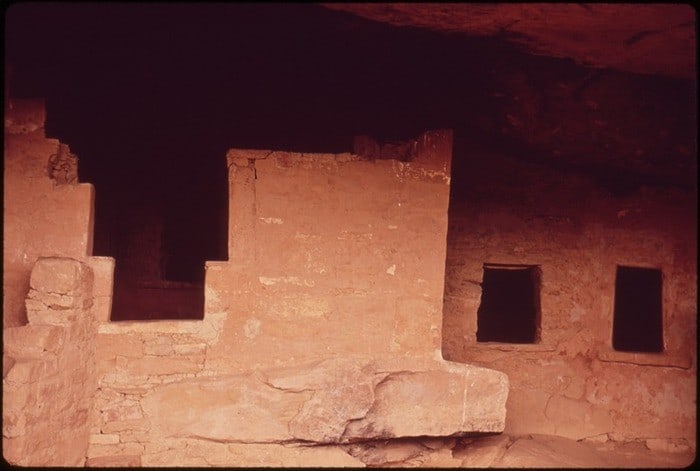
Many of us grew up being taught that Christopher Colombus “discovered” America when he first set sail with the Nina, Pinta, and Santa Maria in 1492. However, we now recognize the insensitivity of such a comment, since America had been populated by people since the Archaic Period (roughly 8000 to 1000 BC). Instead, Colombus merely discovered the continent for the Europeans, who before his voyage had little or no idea that there was a continent standing between it and Asia.
Once Colombus made contact with the American continent and its people, though, these cultures were changed forever, and in many cases, they were erased from history altogether. To this day, historians are unable to say with certainty how many people were living on the American continents before the arrival of Europeans. Estimates range from as low as eight million to as high as 112 million. Yet no matter what the population was before colonization, contact with Europeans decimated indigenous cultures. In some areas, such as in Mexico, nearly 8 percent of the population died by the end of the 17th century, less than 200 years after first contact, from disease
In North America, specifically in the territory that would later become the United States, indigenous populations were significantly smaller, with estimates ranging between 900,000 and 18 million. However, as compared to Central and South America, populations in North America were considerably more spread out. This had a significant impact on the development of US history mainly by encouraging the development of more democratic institutions, as argued by Acemoglu and Robinson (2012).
Their argument states that in North America, where indigenous populations were smaller, early colonial settlements could not rely on the forced labor of natives, as was the case in the Spanish colonies through Central and South America. This meant leadership needed to coerce colonists into working for the collective, and this was often done by granting more freedoms and better representation in government. This then led to the formation of decentralized governments based on democratic values, and these institutions helped foster discontent for British rule and revolutionary sentiment.
Colonial America (1492-1776): The ‘Discovery’ of America
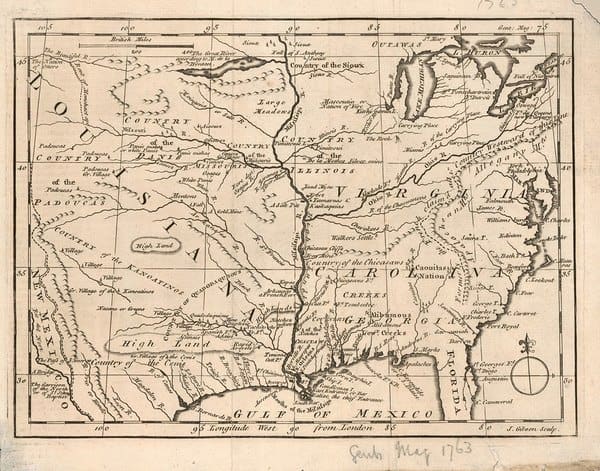
One of the defining moments in US history is the American Revolution, which was fought to free the Thirteen American colonies from the British crown. As a result, we tend to focus on the British colonization of America when studying US history, and while this is certainly important, we must always remember that many other European nations colonized the territory that eventually became the United States of America, such as France, the Netherlands, Sweden, Germany, and, to a lesser extent, Spain.
In instances where formal colonies failed, immigration took place, which helped make the American colonies a diverse mix of European cultures. Furthermore, the slave trade expanded significantly with colonization, which brought millions of Africans to the Americas, and this also reshaped the landscape of colonial American populations.
Over time, European settlements in the Americas changed hands, and they eventually broke their continental ties to became either independent nations (as is the case with Mexico) or parts of the United States.
English Colonization of America
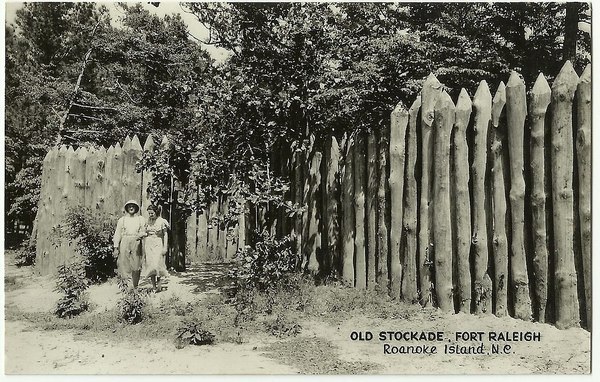
The British were slightly late to the American party when they first attempted to set up a colony on Roanoke Island in 1587. However, this colony, after struggling early on due to harsh conditions and lack of supply, wound up failing miserably. By 1590, when some of the original settlers returned with new supplies, the colony had been abandoned and there was no sign of its original inhabitants.
Jamestown
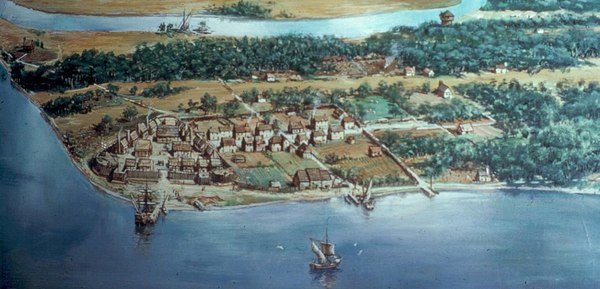
In 1609, the Brtish decided to try again, and under the organization of the Virginia Company, which was a joint-stock company, a new British colony was founded on the American continent: Jamestown. Although the colony struggled early on with hostile natives, harsh conditions, and food scarcity that drove them to cannibalism, the colony survived and became an important colonial center in the early days of British colonization. The colony of Virginia grew up around it and became an important part of colonial politics during revolutionary times.
Plymouth
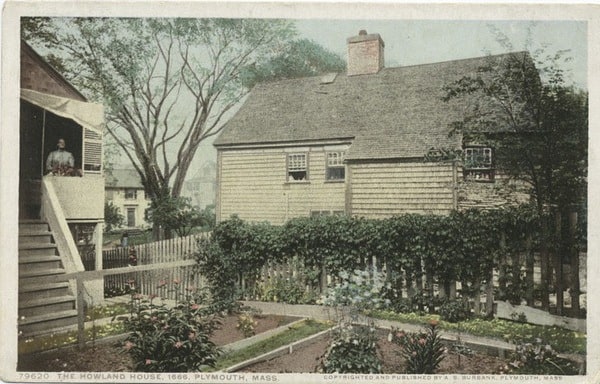
In 1620, seeking freedom from persecution for their Puritan religion, a group of colonists sailed to the “New World” and founded Plymouth, Massachusetts. They were aiming for Jamestown but were blown off course crossing the Atlantic, and they first landed at what is now Provincetown, Massachusetts. However, in Provincetown, there was scarcely any quality farmland, and freshwater was not readily available, so the settlers got back on the boat and sailed further inland to found Plymouth. From there, the colony of Massachusetts grew, and its capital, Boston, became the epicenter of revolutionary activity.
The Thirteen Colonies
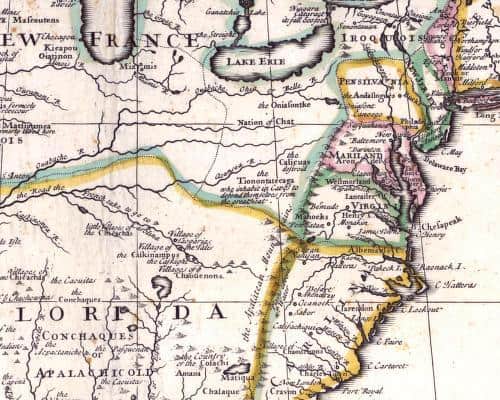
After 1620, British colonization in America grew rapidly. The colonies of New Hampshire, Rhode Island, and Connecticut were founded as extensions of Massachusetts. New York and New Jersey were won from the Dutch in a war, and the rest of the colonies, Pennsylvania, Maryland, Delaware, North and South Carolina, Georgia, were founded throughout the 16th century and became considerably prosperous and independent, a combination that would make them difficult to rule. This set the stage for political turmoil and revolution.
Durng this period, the borders of the colonieds were loosely defined, and settlers often battled with one another for land. One of the best known examples of this was the fight that took place between Pennsylvania and Maryland, which was ultimately settled with the drawing of the Mason-Dixon Line, a border that would go on to serve as the de facto dividing line between the North and the South.
The Rest of America
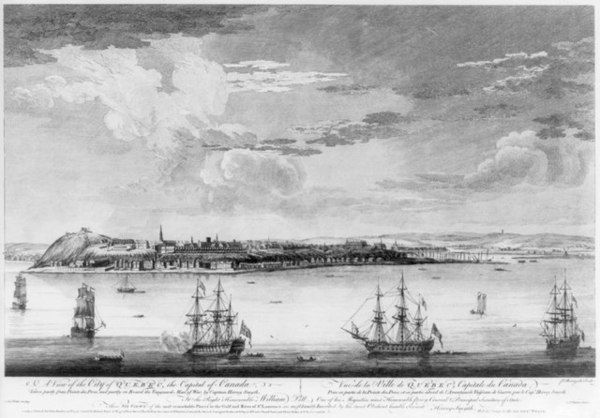
Great Britain also had a considerable colonial presence on the rest of the American continent. They controlled most of what is now Canada after defeating the French in the Seven Years’ War, and they also had colonies throughout the Carribean in areas such as Barbados, Saint Vincent, Saint Kitts, Bermuda, etc.
Spanish Colonization of America
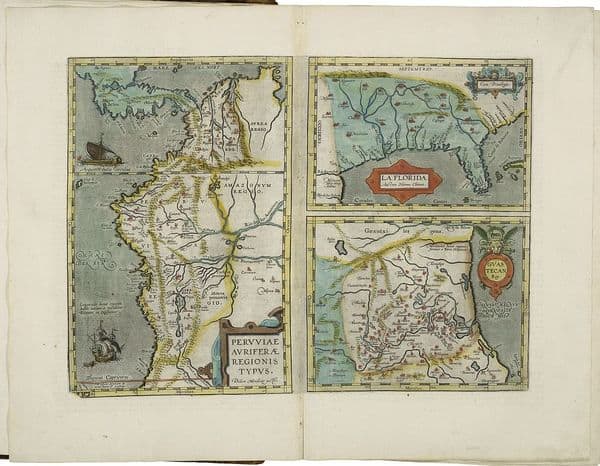
If we take both North, Central, and South America into account, then the Spanish had far and away from the largest presence in what they called the “New World,” and this helped turn Spain into arguably the most powerful nation in the world during the 16th and 17th centuries. In fact, during the early colonial period, Spanish dollars were the de facto currency for much of the colonial world.
But while most of us think mainly of Spain’s colonial presence in Central and South America, the Spaniard also had a significant presence in North America, mainly in Florida, Texas, New Mexico, and California. Much of the territory claimed by Spain would not be ceded to the United States until well after American independence, but many cultural and institutional norms established by the Spanish remained and still do to this day.
Florida
Spanish Florida, which included present-day Florida as well as parts of Louisiana, Alabama, Georgia, Mississippi, and South Carolina, was founded in 1513 by the Spanish explorer Ponce de Leon, and several more expeditions were sent to explore the territory (mainly in search of gold). Settlements were established in St. Augustine and in Pensacola, but Florida was never a focal point of Spanish colonial efforts. It remained under Spanish control until 1763 but was returned in 1783 after a treaty with the British. Spain used the territory to interfere with early American trade, but the territory was eventually ceded to the US and became a state in 1845.
Texas and New Mexico
The Spanish also had a considerable presence in Texas and New Mexico, which were settled and incorporated into New Spain, which was the name given to the vast Spanish colonial territory in North, Central, and South America.
The most significant settlement in Spanish Texas was San Antonio, which became even more important after French Louisiana was incorporated into New Spain as Texas became more of a buffer territory, which caused many colonists to abandon their lands and move to more populated areas. Louisiana was given back to the French and eventually sold to the United States, and border disputes ensued involving Texas.
Eventually, Texas broke free from Spain as a result of the Mexican War of Independence, and Texas remained independent for some time until being incorporated into the United States.
California
Spain also colonized much of the western coast of the North American continent. Las Californias, which included the modern-day US state of California, as well as parts of Nevada, Arizona, and Colorado, as well as the Mexican states of Baja California and Baja California Sur, were first settled in 1683 by Jesuit missionaries. Additional missions were set up throughout the territory, and the area became a more significant part of New Spain. But when Mexico won its independence from Spain and then fought and lost the Spanish-American War, much of Las Californias was ceded to the United States. The California territory became a state in 1850, and the rest of Las Californias followed suit in the decades after.
French Colonization of America
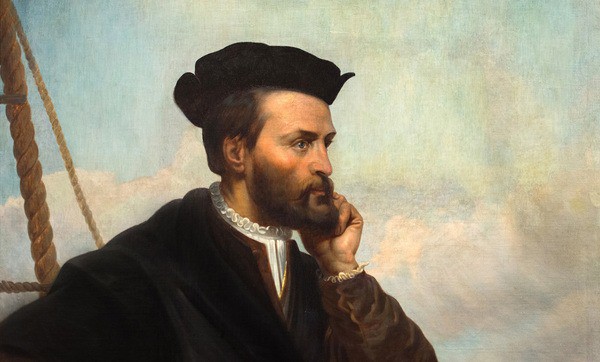
Jacques Cartier first colonized North America for the French in 1534 when he landed at the Gulf of Saint Lawrence. From there, French colonies popped up all over what is the modern-day nation of Canada and the midwestern United States. The colony of Louisiana included the important port city of New Orleans, and also included much of the territory surrounding the Mississippi and Missouri Rivers.
However, French colonial efforts in North America were significantly diminished after 1763 when they were forced to cede most of Canada and Louisiana to England and Spain as a result of losing the Seven Years War.
France would regain control of Louisiana in 1800, but then Napolean Bonaparte sold it to the United States. Known as the Louisiana Purchase, this was a groundbreaking moment in US history as it set the stage for a significant period of westward expansion that led to economic growth in the United States. It’s also significant because it ended French colonial efforts in North America.
Dutch Colonization of America
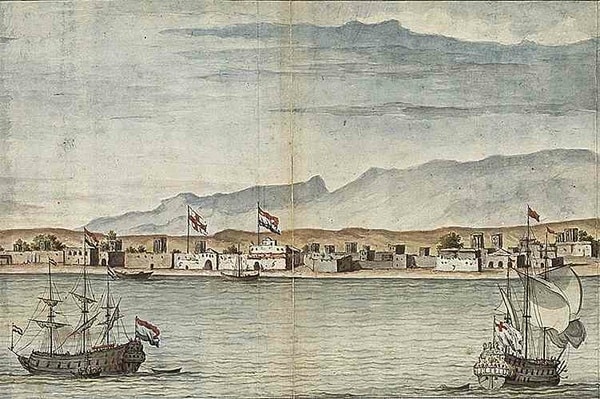
The Netherlands was a rich and powerful nation during the 16th century, and they bolstered this prosperity with colonies throughout most of the world. In North America, the Dutch East India Company, in an attempt to enter the North American fur trade, set up the colony of New Netherland. The center of the colony was in present-day New York, New Jersey, and Pennsylvania, but the Dutch claimed the territory as far north as Massachusetts and as far south as the Delmarva Peninsula.
The colony grew considerably throughout the 17th century, with its main port, New Amsterdam (which later became New York), turning into a considerable seaport where trade was conducted between Europe and its colonies. However, after the Second Anglo-Dutch War, which ended in 1664, the territories of New Amsterdam were turned over to the British. The Dutch took the territory back but lost it again in the Third Anglo-Dutch War (1674), bringing this territory under English control once and for all. It’s estimated that some seven or eight thousand people lived in the colony (as well as 20 suspected witches), and many continued to do so even after it officially came under the authority of the English crown.
Swedish Colonization of America
Sweden set up settlements in present-day Delaware, Pennsylvania, and New Jersey along the banks of the Delaware River. The colony, named New Sweden, was established in 1638, but it only lasted until 1655. Border disputes with the Dutch, who controlled the territory to the North, led to the Second Northern War, which the Swedes lost. From this point on, New Sweden became part of New Netherland, which eventually became
German Colonization of America
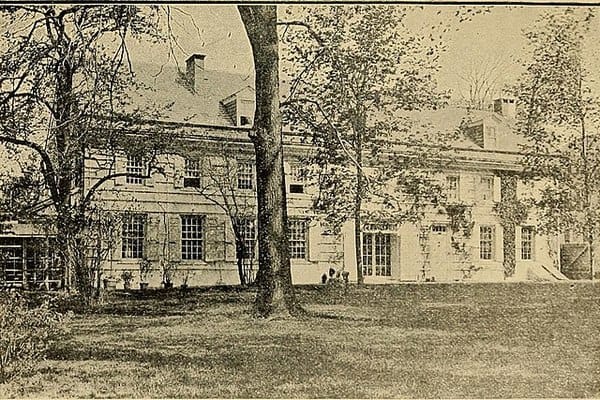
While England, France, the Netherlands, and Sweden were colonizing North America, there was no unified Germany. Instead, the German people were divided up into various German states. This meant that there was no coordinated colonization effort by the Germans while North America was being colonized.
However, large numbers of German people, seeking religious freedom and better economic conditions, migrated to the United States during the 16th and 17th centuries, settling mostly in Pennsylvania, Upstate New York, and the Shenandoah Valley in Virginia. Germantown, which is located just outside Philadelphia, was founded in 1683 and was the first and largest German settlement in North America.
In fact, immigration was so significant that around half of Pennsylvania’s population in 1750 was German. This would have a significant impact on US history in the 19th century when large numbers of Germans immigrated to the US, and some went on to become rather powerful, with one of the most famous examples being John Jacob Astor,
Interestingly, Germans fought on both sides during the American Revolution. German mercenaries, known as Hessians, were hired by the British, yet Prussian generals also helped train and outfit the Continental Army so that it could fight more evenly against the infamous Britsh army.
The American Revolution (1776-1781)
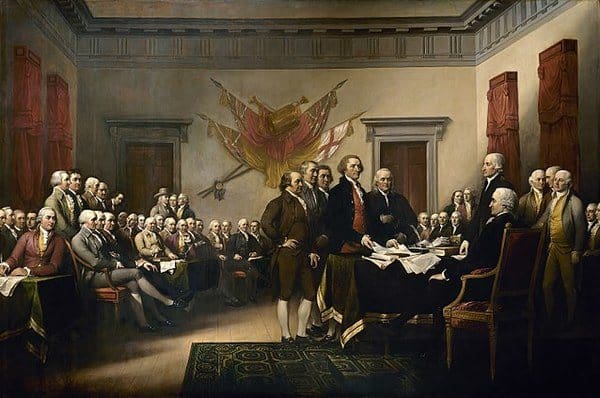
John Trunbull’s depiction of the Declaration of Independence can be found on the back of the US$2 bill
In just under a century, the American continent went from being unknown to the European world to being entirely dominated by it. Native populations had been fought back, and many were dying at rapid rates due to the diseases carried over by Europeans.
READ MORE: The American Revolutionary War: The Dates, Causes, and Timeline in the Fight for Independence
In the Thirteen British Colonies, which were located along the east coast of today’s United States, economic growth, religious freedom (to a certain extent), and political autonomy defined the day. Colonists had considerable opportunities to better their futures through work and business, and local self-governments had been established throughout the colonies and tolerated by the crown, and many of these institutions were rather democratic in nature.
As a result, when the British crown decided to enact measures designed to better control the colonies and extract more value from them so as to pay for foreign wars and other imperial matters, many colonists were not pleased. This launched a considerable separatist movement, which gained steam throughout the 1760s and early 1770s before eventually resulting in the Declaration of Independence, which was followed by the Revolutionary War fought between the colonists and those loyal to the Crown. Obviously, the colonists won this war, and the nation of the United States of America was established.
Taxation Without Representation
Starting in 1651, the British crown made it clear that the colonies in the Americas were to be subservient to the king by passing the series of acts known as the Navigation Acts. This series of laws put severe restrictions on American trade by essentially prohibiting American merchants from trading with any other country except Great Britain. This caused significant problems for the wealthy merchant classes of Colonial America, which just so happened to be the same people who had the status and influence to foment a revolution within the colonies.
Throughout the next two decades, revolutionary sentiment spread alongside increasingly draconian measures taken by the British crown. For example, the Proclamation of 1763 prevented colonists from settling west of the Appalachians, and the Sugar Act (1764), Currency Act (1764), and the Stamp Act (1765), the Quartering Act (1765), the Townshend Acts (1767) put even more stress on American-British relations.
This lead to the belief that American colonists, who were technically subjects of the crown, did not share the same benefits as other English subjects, mainly that they had no means of controlling the laws and taxes set upon them. In other words, they were experiencing “taxation without representation.”
Protests became more common throughout the 1760s, and many colonies set up Committees of Correspondence to communicate with one another and to discuss matters of the day.
However, war did not seem imminent until 1773 when a large group of British colonists, led by Samuel Adams, decided to dump millions of dollars (in today’s money) worth of tea into Boston harbor as a way of protesting the Tea Act. The Crown responded with harsh punishments known as the Intolerable or Coercive Acts, and this pushed the colonies to their tipping point.
Outbreak of War
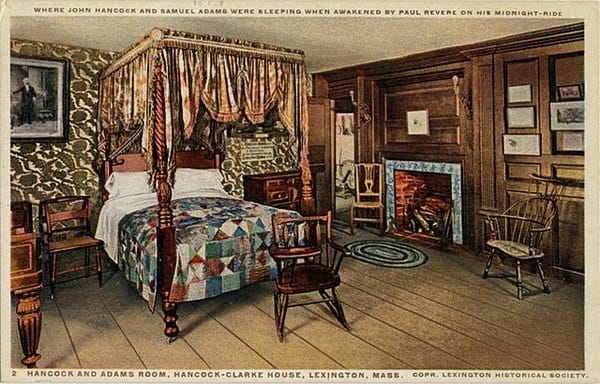
The first shots of the American Revolution were fired on April 19, 1775, in Lexington, Massachusetts. Hearing of the British plans to march to Concord, Massachusetts to colonial arms, colonists bound together in militias to stop them.
It was during this battle that Paul Revere made his famous midnight ride, and the first shot fired at Lexington became known as “the shot heard round the world” because of its dramatic implications in world politics. The colonists were forced to retreat at Lexington, but militias from all over met the British on their route to Concord and inflicted enough damage that they were forced to abandon their advance.
The Battle of Bunker Hill, which took place in Boston, came shortly thereafter, and although the battle ended in a British victory, the colonists inflicted heavy wounds on the British army, leaving many to wonder what the cost of victory really was.
At this point, Diplomacy took over once again. At a meeting of the Second Continental Congress (1775), the delegates wrote up an Olive Branch Petition and sent it to King George which essentially said, “give in to our demands or we will declare independence.” The king ignored this petition, and conflict continued. The colonists tried and failed, to invade Canada, and they also laid siege to Fort Ticonderoga.
Recognizing that there would be no other recourse other than war, the delegates of the Second Continental Congress met and commissioned Thomas Jefferson to write the Declaration of Independence, which was signed and ratified by Congress on July 4, 1776, and published in newspapers around the world, giving new cause to the military struggle between Great Britain and its American colonies.
The War Continues
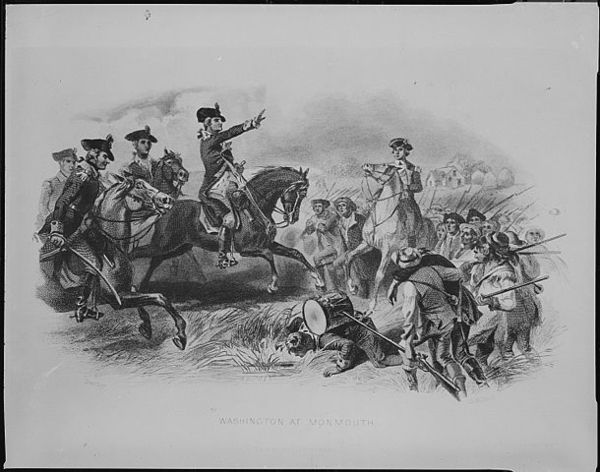
After the Declaration of Independence, the military struggle between Great Britain and its American colonies became a battle for independence. The Continental Army, led by General George Washington, managed to march back into Boston and put it back under colonial control after the British took it after the Battle of Bunker Hill.
From there, the British Army focused on New York City, which they took after the Battle of Long Island. New York would serve as a focal point for the British and colonial Loyalists, those who chose to remain a part of the British empire.
Washington crossed the Delaware on Christmas Day of 1776 and surprised a group of British and Hessian soldiers in Trenton. They won a decisive victory that proved to be a rallying point for the struggling Continental Army. This was followed up by the American victory at the Battle of Trenton (1777).
Throughout 1777, several more battles were fought in upstate New York, with the most significant being the Battle of Saratoga. Here, the Continental Army managed to destroy or capture nearly the entire force it was fighting against, which essentially halted the British war effort in the North. This victory also proved to the international community that the colonists had a chance, and France and Spain rushed in to support the Americans in an attempt to weaken the Britsh, one of their all-time biggest rivals.
The War in the South
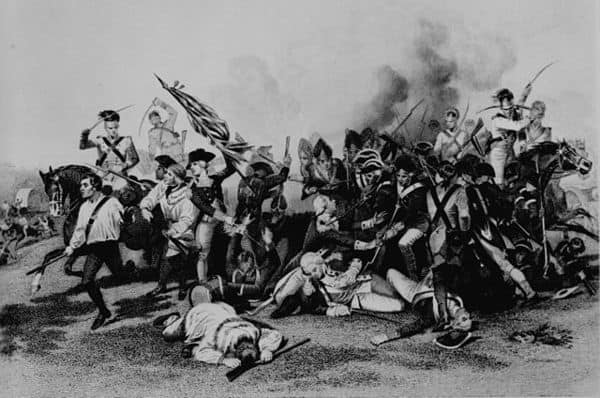
After the Battle of Saratoga, the British had all but lost the North, and so they refocused their efforts in the south. At first, this appeared to be a good strategy, as both Savannah, Georgia, and Charleston, South Carolina surrendered to the British by 1780.
The Battle of Camden (1780) was also a decisive British victory, giving hope to the loyalists that the war could be won after all. However, after the Patriots defeated a loyalist militia at the Battle of King’s Mountain, Lord Cornwallis, the general in charge of the southern campaign, was forced to abandon his plan to invade South Carolina and instead had to retreat into North Carolina.
In the South, many of the Patriot militias took to guerilla warfare, using the swampy, tree-ridden terrain of the southern United States to engage with the British army in less than traditional ways. One of the leaders of this movement, Francis Marion, also known as the Swamp Fox, was crucial to the southern war effort and helped make victory possible. The Patriots, using this tactic, won several key battles throughout 1780 that put them in an excellent position for success. But we should also point out that the British, who were beginning to focus on other issues in the empire, stopped reinforcing the army in the colonies, which has often been taken as a sign that the crown had accepted that the colonies would indeed win their independence soon enough.
The war came to an end when, in 1781, Lord Cornwallis and his army were eventually surrounded in Yorktown, Virginia. French ships blockaded the Chesapeake, and the Continental Army outnumbered the redcoats, leading to a full surrender and the end of the American Revolution War.
The Early Republic (1781-1836)
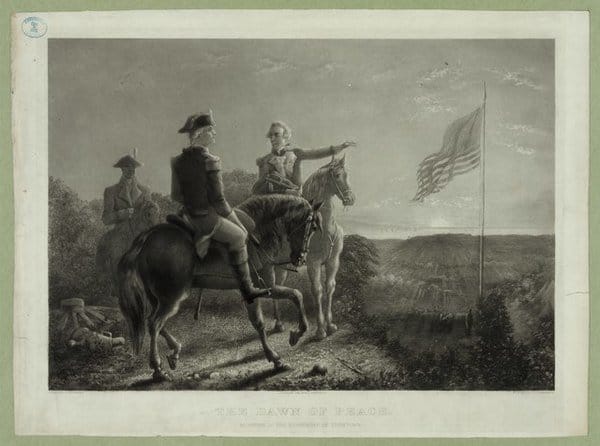
After the British surrendered at Yorktown, the thirteen original colonies ceased to be colonies and were granted their independence. However, much was to be done before the newly independent colonies could call themselves a nation.
The Terms of Peace
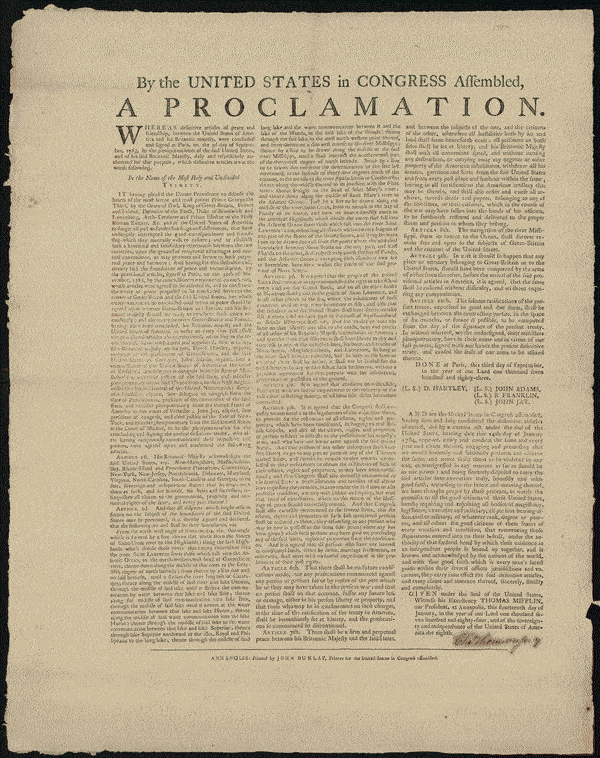
The first thing was to formally end the Revolutionary War. This happened with the signing of the Treaty of Paris of 1783. The treaty established the sovereignty of the United States, and it also identified boundaries of the new country, which were to be the Mississippi River to the West, Spanish Florida to the South, and British Canada to the North.
The treaty also allowed American fishermen to work off the coasts of Canada, and it set up rules and guidelines for restoring property to loyalists, as well as for paying back debts incurred before the war. In general, the treaty was quite favorable for the United States, and this is likely the result of the British desire to become economic partners with the rapidly growing United States.
Several other treaties were signed in Paris during 1763 between Great Britain, France, and Spain, all belligerents in a much larger war of which the American Revolution was fought. These treaties, which are known collectively as the “Peace of Paris,” coordinated the exchange of captured territory, and also officially recognized the United States as being free and independent from the control of the British crown.
The Articles of Confederation
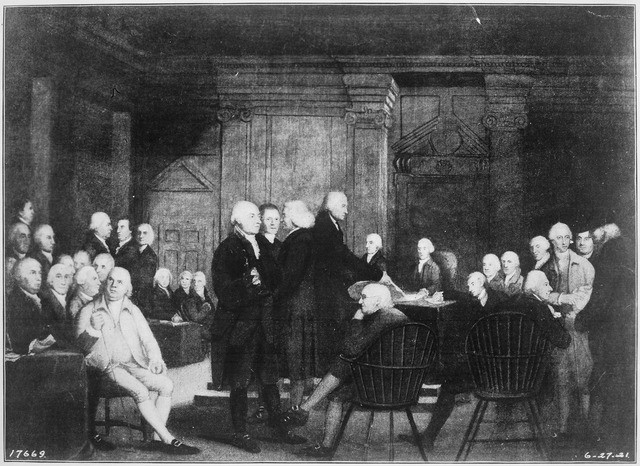
Now free from the British Crown, the colonies needed to decide how to set up their government. Having enjoyed the use of local, autonomous self-government for most of the colonial era, Americans were wary of a strong central government and wanted the government to be as limited as possible to reduce the risk of experiencing the tyranny they had experienced when part of the British Empire. This led to the passing of the Articles of Confederation, which were drafted by the Second Continental Congress in 1777 and ratified by the states in 1781, while the American Revolution was still going on.
However, by creating a framework of government that so severely restricted the power of that government, the Confederation Congress, which was the new name given to the Continental Congress, found it very difficult to do much on a national level. However, they did enact several policies, such as the Land Ordinance of 1785 and the Northwest Ordinance, which helped establish rules for settling new territory and for adding states to the union.
Despite this progress, though, the Confederation Congress was still quite weak. It lacked the ability to regulate issues of common interest among the states, such as trade and defense, and it also did not have the power to raise taxes, which limited its effectiveness. As a result, states started meeting amongst themselves to work out issues of common concern, a good example being the Mount Vernon Conference of 1785 in which Virginia and Maryland met to negotiate how to use their shared waterways. But this was just one of many examples where the states needed to go around the federal government to be able to make arrangements for the benefit of all, calling into question the effectiveness of the Articles of Confederation.
Then, in 1787, when Shay’s Rebellion broke out in 1787 in Springfield, Massachusetts in response to the state’s attempt to collect taxes, and the federal government had no military to suppress it, it became clear the Articles of Confederation were too weak of a framework for an effective national government. This started a movement led by prominent congressmen such as James Madison, John Adams, John Hancock, and Benjamin Franklin, to create a new type of government that would be stronger and more effective.
The Constitutional Convention of 1787
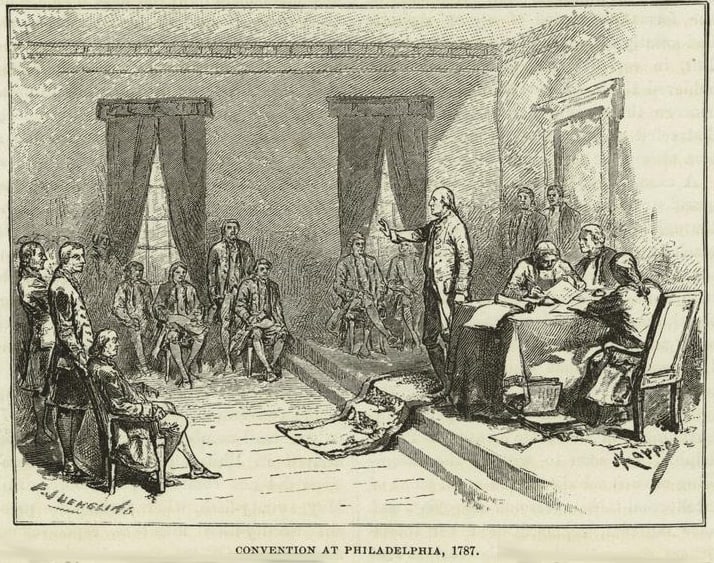
In September of 1786, twelve delegates from five states met in Annapolis, Maryland to discuss how trade should be regulated and supported amongst the states. This is because the Articles of Confederation set up a situation in which each state was an independent body, which led to protectionist policies that stymied trade and hindered the development of the United States of America. Four other states had planned to attend the convention, but the delegates did not arrive in time. However, by the end of the convention, it became clear that there was a need to revisit the structure of the new American government to make it stronger and more effective in promoting the country’s growth.
In May of the following year — 1787 — fifty-five delegates from all states except Rhode Island met in the Pennsylvania State House (Independence Hall) to discuss further changes to the Articles of Confederation. However, after several weeks of intense debate, it became clear that the Articles were simply too limited and that a new document needed to be created for the country to move forward, one that laid out the groundwork for a stronger and more effective federal government.
The Great Compromise
Delegates then formed groups and drafted different proposals, the most famous being the James Madison’s Virginia Plan and William Patterson’s New Jersey Plan. The main difference between the two was that the Virginia plan called for two legislative bodies that were elected based on population, whereas the New Jersey plan, which was drafted by delegates from smaller states, advocated for a one-vote-per-state plan to prevent the larger states from having too much power.
In the end, the delegates of the convention decided for a mixture by agreeing to a bicameral legislative body in which one part would be elected based on population (the House of Representatives) and one would give each state equal representation (the Senate). This agreement is known as the Great Compromise or Connecticut Compromise, as it was envisioned and promoted by Henry Clay, a delegate from the State of Connecticut.
The Three-Fifths Compromise
Once this compromise was reached, the delegates had a foundation for government. But some key issues remained, one of which, slavery, would continue to haunt American politics for more than a century. The southern states, the economies of which ran almost exclusively on slave labor, wanted to count their slaves as part of their population, as this would give them more votes in the House of Representatives and more power. The Northern states obviously objected as they did not rely on slave labor and counting population in this way would leave them at a severe disadvantage.
This issue stalled the Convention, but it was eventually resolved with what is now known as the Three-Fifths Compromise. This arrangement stipulated that the southern states could include the three-fifths of their slave population in their official population count. In other words, each slave was counted as three-fifths of a person, a perspective that reflected the highly-racists attitudes prevalent throughout the United States at its inception, a perspective that would lead to the oppression and subjugation of blacks that arguable exists until the present day.
The Slave Trade and Fugitive Slaves
Slavery was a constant issue at the convention. In addition to the above compromise, delegates also had to work out the power Congress had over the slave trade. Northern state wanted to ban it and slavery altogether, but they were forced to concede this point. But the delegates agreed that Congress had the power to eliminate the slave trade, but they would not be able to exercise this power until 20 years after the signing of the document. In addition, the delegates also worked out the terms of the Fugitive Slave Clause.
Most of this was done to appease the Southern delegates who refused to sign any document that restricted slavery. This was a harbinger of things to come. Sectional differences continued to haunt the country after the signing of the constitution and eventually led to civil war.
Signing and Ratification
After working out their many differences, the delegates finally had a document they thought would be an effective plan for government, and on September 17, 1787, nearly four months after the Convention began, thirty-nine of the fifty-five delegates signed the document. It was then put before Congress, which briefly debated whether or not to censure the delegates for drafting a new government instead of performing the original task of merely modifying the Articles of Confederation. But this matter was dropped, and the Constitution was sent to the states for ratification.
Article VII of the Constitution indicated that nine of the thirteen states needed to ratify the Constitution for it to take effect. The majority of the delegates had signed the document, but this did not mean the majority of the states supported its ratification. Those in favor of the Constitution, known as Federalists, worked to win the support of the people, whereas the Anti-Federalists, who were opposed to a strong central government and preferred a government similar to that laid out by the Articles of Confederation, tried to prevent the Constitution’s ratification.
The Federalists began publishing the Federalist Papers in support of their cause. This division between Federalist and Anti-Federalists marked some of the key differences in public opinion in the early years of the Republic, and they also laid the groundwork for the country’s first political parties.
The first state to ratify the Constitution, Delaware, did so on December 7, 1787, less than two months after the convention concluded. However, the other nine took ten months to ratify, and it wasn’t until one of the chief Federalists, James Madison, agreed that establishing a Bill of Rights to protect individual freedoms would be the first act of the new government, did states skeptical of a strong central government agree to the new constitution.
New Hampshire ratified the Constitution on June 21, 1788, giving the document the nine states it needed to become legal. The remaining four states: New York and Virginia, two of the most powerful states at the time, ratified after the document became legal, avoiding a potential crisis, and the remaining two, Rhode Island and North Carolina also eventually also ratified the document. However, North Carolina did not do so until 1789, after the Bill of Rights had been passed, and Rhode Island, which initially rejected the document, did not ratify until 1790. But despite the struggle, the delegates succeeded in creating a document that pleased all, and the new government of the United States had been created.
The Washington Administration (1789-1797)
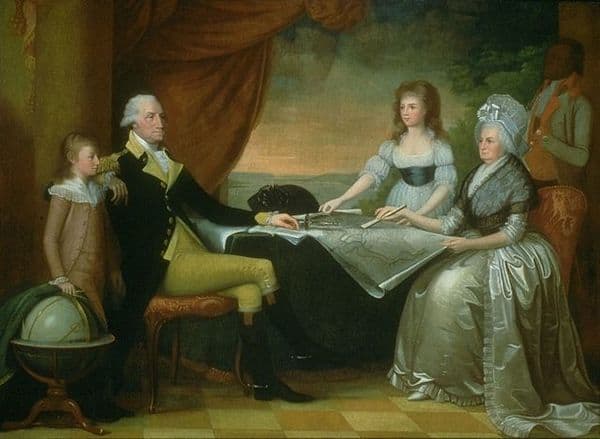
After the Constitution had been signed and ratified, the Electoral College, an independent body tasked with electing the nation’s executive, met at the end of 1788 and elected George Washington as the nation’s first president. He took office on April 30, 1789, marking a new era in the nation’s history.
Washington’s first order of business was to pass the Bill of Rights, which was a promise made by the Federalists to the Anti-Federalists in exchange for their support of the constitution. The document was first drafted in September of 1789 and included rights such as the right to free speech, the right to bear arms, and protection against unreasonable search and seizure of property. It was ratified (the Bill of Rights is technically a set of amendments to the constitution, meaning it needed a two-thirds majority from the state to take action) on December 15, 1791.
Washington also oversaw the passing of the Judiciary Act of 1789, which laid out the framework for the judicial branch of government, something that was excluded from the Constitution. He also participated in the Compromise of 1790 to move the nation’s capital to an independent territory to be known as the District of Columbia.
Modern historians praise Washington for his cabinet choices, as he actively chose not to surround himself with sycophants and supporters. A Federalist himself, Washington chose Alexander Hamilton, a strong Federalist, to be his Secretary of Treasury, but he chose Thomas Jefferson, an avid anti-Federalist, to be Secretary of State. Jefferson and Hamilton differed on many issues, one of the most significant being the choice between France and Great Britain as an ally. Jefferson also felt that the government should focus on supporting agriculture over industry, whereas Hamilton saw industry as the best way forward. Hamilton won out in this debate when the Jay Treaty, which dealt with some outstanding issues between the US and Great Britain, was negotiated.
Another major moment of Washington’s administration was the Whiskey Rebellion, which Washington responded to by sending Federal troops, which were amassed thanks to the Militia Law of 1792, which helped show the newfound power of the Federal government. However, perhaps one of the most significant contributions Washington made to the nation was his decision to not seek a third term in office. The Constitution did not set limits, yet Washington chose to step down, a precedent that would not be broken until the 1930s.
However, when Washington left office, he departed an increasingly hostile political environment in which factions and political parties were rapidly forming, which led to the First Party System. This trend would continue during the next several presidencies, setting the stage for an early political crisis in the new nation.
The Adams Administration (1797-1801)
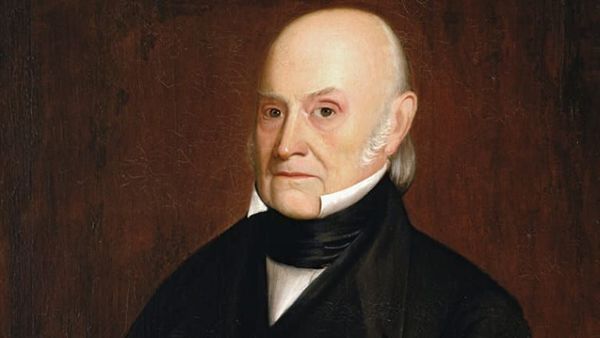
When John Adams took over as the second president of the United States in 1797, the country was already experiencing significant division. On the one side was Adams, Washington, Hamilton, and the Federalist party, which had managed to win popular support in the early years of the Republic. However, on the other side were the Republicans, led principally by Thomas Jefferson, who served as Vice President under John Adams. But factions within each party made it difficult for Adams to run his administration, and it opened the door for a shift in American politics.
To make things worse for Adams, his administration needed to deal with significant pressure from France. Angered by the Jay Treaty, which was favorable to Britain and left France, who had supported American in its Revolutionary War, at a disadvantage, the French began seizing American trade ships, a move that caused an economic decline in the new nation.
In response, Adams sent ambassadors to France, an event known as the XYZ Affair, to negotiate peace, but France, recognizing the weakness of the United States, forced the Americans to loan them money and refused to pay debts it owed to the US for seized property. This launched a widespread Anti-French movement in the United States, and it even led to a series of military conflicts between the US and France which became known as the Quasi-War.
As a result of these sentiments, the Federalist Adams administration managed to pass the Alien and Sedition Acts, which prohibited anyone from writing or speaking negative things about the president and congress, as well as the Naturalization Acts, which changed the residency requirement for citizenship from five to fourteen years.
Both acts were designed to stamp out pro-French rhetoric in America, but the Jeffersonian-led Republicans used this as ammunition in their fight against the Federalists by claiming they were trying to use the power of the central government to limit the individual freedoms upon which America had been founded. In response to what was perceived as a tyrannical policy, several states spoke up about their right to ignore the laws of Congress they deemed wrong or unfair. This concept, which became known as nullification, was outlined in the Kentucky and Virginia Resolutions, and although dismissed by the rest of the states, became an issue as the young nation attempted to work out the balance of power between the states and the federal government.
With the threat of war with France growing, Adams also established the US Navy, which he needed to pay for by incurring more debt and also raising taxes, a move that was not popular with the Republicans. All this meant that by 1801, when it was time for Adams to seek reelection, he had lost favor with much of America, making him the first one-term president in US history.
The Jefferson Administration (1801-1809)
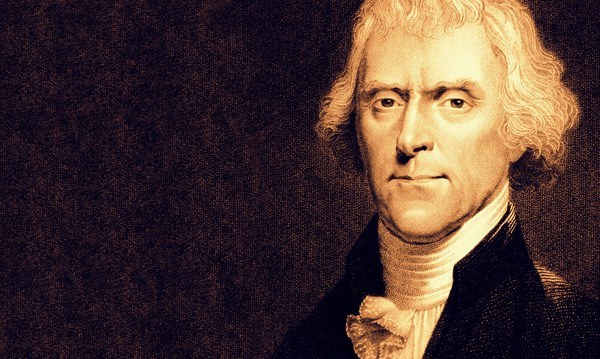
By the time Thomas Jefferson, the de facto leader of the Democratic-Republican Party, took office in 1801, the capitol building in Washington, D.C. was completed, making Jefferson the first president to live in the White House. Also, after the Quasi-War, France realized that it would be more costly than it was worth to interfere with US trade, and the conflict between America’s former ally subsided. As a result, one of the first things Jefferson did was slash military spending and reduce the size of the army and navy. Additionally, as a champion of small government, he made considerable cuts to the size of several government departments, which helped significantly reduce the size of the national debt.
Jefferson had been one of the most outspoken (although in written words only) of the ideals behind the American revolution, and he saw America as a champion of liberty around the world. This led him to be a great sympathizer of France, which had undergone a revolution not long after the United States broke free from Great Britain. As a result, his focus as president was more outward than inward, choosing to take a hands-off, or laissez faire, approach to domestic affairs while working to expand democracy and liberty to new lands.
Of his domestic policies, the most important were repealing the Alien and Sedition Acts and nullifying the Naturalization Act. Jefferson also illegalized the international slave trade, which he had the right to do starting in 1807 due to the stipulation in the Constitution that Congress had to wait twenty years before touching this institution.
The most famous example of this is the Louisiana Purchase. Plagued by war and his own domestic issues, Napoleon, the emperor of Democratic France, had little to no need for his American lands, and so he sold them to Jefferson and the United States, which more than doubled the amount of territory controlled by the new nation. Jefferson the commissioned the Lewis and Clark Expedition to explore this new territory and to reach the other side of the continent, planting the seeds for the concept of Manifest Destiny, which would take further root under President Andrew Jackson.
However, despite Jefferson’s attempts to reduce the size of the Federal government, the Federal judicial system became significantly more powerful during the Jefferson administration due to the landmark Supreme Court case Marbury v. Madison. This ruling essentially gave the Supreme Court the power to overturn laws made by Congress, a power that had not been outlined by the Constitution but that has been one of the main functions of the court ever since.
By the end of Jefferson’s presidency, though, tensions were once again on the rise with America’s overseas counterparts Britain and France. The British had begun to impose a blockade on American trade in response to American support to the French, and Jefferson responded with the Embargo Act of 1807, which banned all trade from foreign nations. However, instead of protecting American agriculture and industry and harming the French and British, this protectionist policy devastated the American economy, and Britain, which had managed to find other sources of food, saw an opportunity to strike at its former colonies while it was weak, putting the new nation to its biggest test yet.
The Madison Administration (1809-1817)
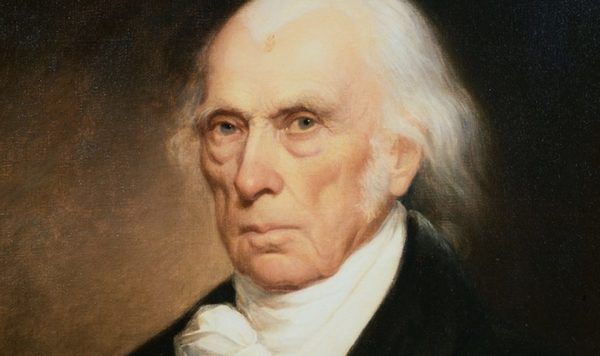
When James Madison won the presidential election in 1809, the United States found itself in what amounted to another war of independence. Due to its small navy and army, the Americans had no way of forcing the British and the French to respect freedom of the seas, and the British policy of impressment, which allowed them to seize and board American ships, devastated trade, despite Madison’s move to repeal the Embargo Act of 1807. In addition, the British had been funding Native American tribes on the American frontier, which hindered American expansion and economic growth. This led to a strong appetite for war, except in the Federalist north where industry was strong and the money was flowing, and Madison responded by asking Congress to declare war on the British, which they did in 1812.
The War of 1812
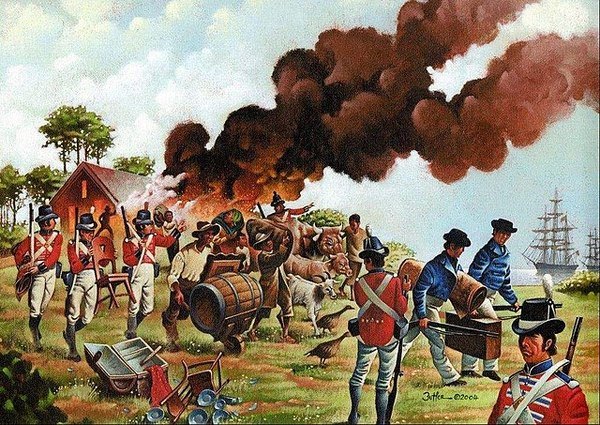
Less than twenty-five years after the American Revolution, fighting between the United States and Great Britain resumed. In general, the United States was ill-prepared to fight this war, especially after Jefferson had reduced the army and navy to practically nothing during his time as president. This lead to a series of defeats at the beginning of the war that put the nation in danger. This includes the Siege of Detroit (1813), the Battle of the Thames (1813), the Battle of Lake Erie (1813), and the Burning of Washington (1814).
However, in 1814, the Americans, led by General Andrew Jackson, stormed into New Orleans and won the Battle of New Orleans. This all but destroyed the British army and encouraged them to sue for peace. The two nations signed the Treaty of Ghent in 1814, which restored relations to how they were before the war. But this conflict had significant implications in the U.S. First, it showed the resiliency of the nation since it was once again able to defeat Great Britain despite having the odds against it, and it also instilled a great sense of national pride, which would help define the next era of American history. Furthermore, because of his success in the war, Andrew Jackson became a national hero, and he would eventually ride this fame to the presidency.
Antebellum Period (1814-1860)
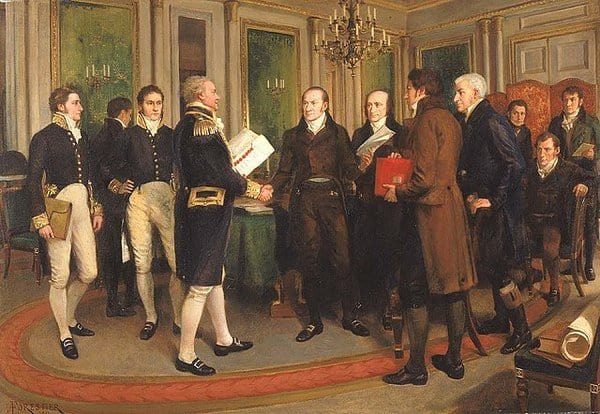
The next period of American history, which spans roughly from the end of the War of 1812 until the beginning of the Civil War is often called the Antebellum Period, or the Pre-War Period. This is because when we look back at American history, it’s easy to see how the events of this period were hurling the nation towards civil war, which is arguably the most defining moment in the nation’s 300-year history. Of course, those living during this period did not see war as an imminent threat, at least not in the early years of the Antebellum Period. In fact, many of the people living in America at the time would have experienced prosperity, peace, and expansion.
The Era of Good Feelings
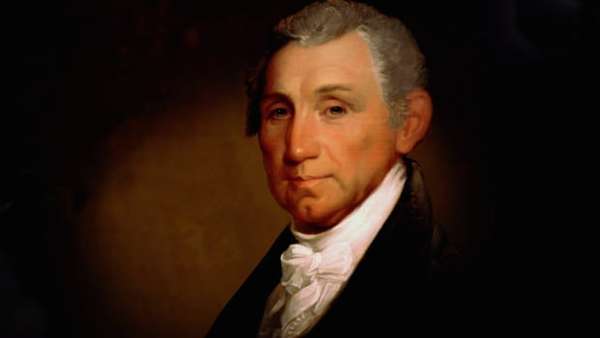
James Monroe took over as president in 1817 and his time in office was known as the “Era of Good Feelings” due to the national pride felt from victory over Britain as well as the decline in hostile rhetoric in politics. However, these “good feelings” would not last as the country continued to experience the growing pains of a new nation. For one, the Federalist party had all but disappeared thanks to the Hartford Convention and the New England states’ threat to secede as a result of their opposition to the War of 1812. This marked the beginning of sectionalism, a phenomenon in which political concerns are isolated within a geographical region, a frequent precursor to civil war. New political parties also emerged, such as the Whigs and the National Republicans, which threatened national unity.
The Panic of 1819 marked the beginning of the US’s first peacetime economic crisis, and this led people to doubt and oppose central banks. The Supreme Court case, Mcculloch v. Maryland, asserted the power of the central government and its banks, and it also expanded the rights of the federal government as compared to that of the states.
Another crisis occurred when Missouri, the first territory from the Louisiana Purchase to request statehood, asked to be admitted as a slave state. With this, the sectional issue of slavery was thrust to the forefront of American politics. The Missouri Compromise solved these problems temporarily by extending the Mason-Dixon Line into the western United States, serving as the unofficial but generally recognized border between Southern slave states and Northern states where slavery was neither allowed nor practiced.
However, as new states began to enter the union, this issue of slavery continued to be a sticking point, and it would fuel tensions within America until the outbreak of war.
The Second Great Awakening
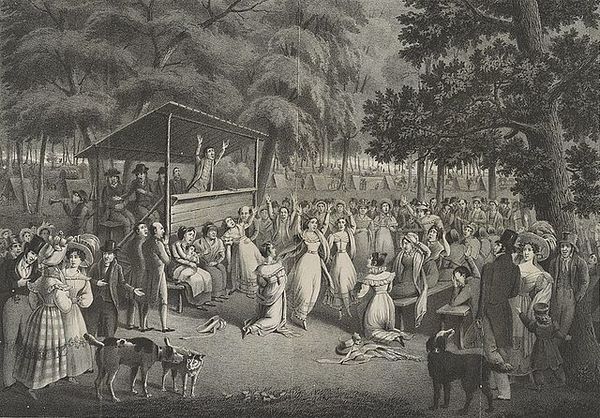
After the War of 1812, the United States went through what is called the Second Great Awakening, which was essentially a religious revival movement that restored the role of religion in early America. It was at this point that the United States, which was growing rapidly, began to develop its own high culture, one that included literature and music distinct from that of Europe.
The Second Great Awakening also gave life to other movements, such as the public schools movement, which expanded access to education, as well as the abolitionist movement, which sought to outlaw slavery from the United States. As one might expect, movements against slavery touched on a sensitive issue in the early United States that fueled sectional differences and brought the country closer to conflict.
Westward Expansion and Manifest Destiny
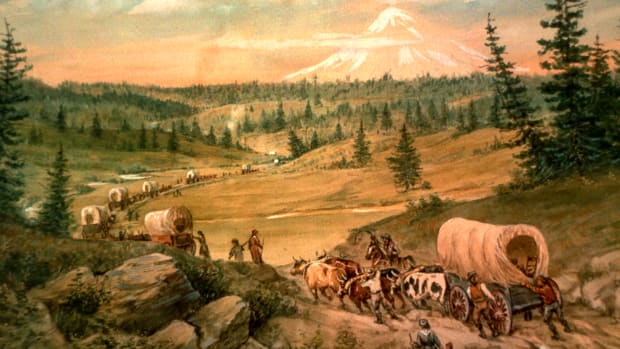
Another important cultural development that took place during the Antebellum period was the spread of the concept of Manifest Destiny. This was the idea that it was God’s will for America, in defense of liberty, to extend from “sea to shining sea.” In other words, it made continental expansion a goal for the United States, which fueled both nationalism and westward expansion. This led to frequent wars and other conflicts with Native American tribes, as well as cruel policies such as the Indian Removal Act, which led to the trail of tears. It also led to an increased appetite for wars that had a territorial gain as their primary aim.
As people began moving west, the United States expanded rapidly, with 15 new states (two more than the original 13) added between 1791 and 1845. This rapid growth made economic development easier, but it also fueled the issue of slavery.
The Mexican-American War (1846-1848)
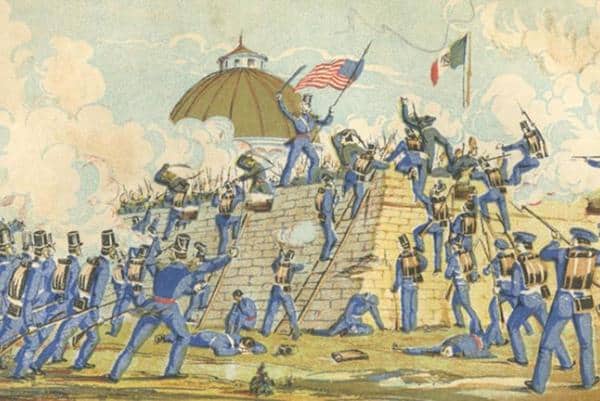
The Mexican-American War was the first war fought between the United States and an independent foreign power since the War of 1812. It started after Texas, which declared independence from Mexico in 1836, was annexed to the United States in 1845. The Mexicans saw this as a slight against their sovereignty and attacked an outpost of American troops on the Texas border. Congress responded with a declaration of war, and the Mexican-American War began.
After winning several key battles in and around Texas, the two sides began to sue for peace, but negotiations broke down. The US army then marched into Mexican territory and captured the city of Veracruz, and they entered and occupied the Mexican capital, Mexico City. This led the Mexican president at the time, Antonio Lopez de Santa Ana, to flee and sue for peace. In the terms of the peace agreement, known as the Treaty of Guadalupe Hidalgo, the Rio Grande was established as the southern border of Texas, and Mexico ceded the territories of California, New Mexico, Nevada, Colorado, Arizona, and Utah to the United States in exchange for $15 million.
The Mexican-American War was yet another boost for American nationalism. It was during this war that the famous Battle of the Alamo was fought, which further entrenched figures such as Daniel Boone and Davy Crockett as symbols of the American frontier, and Zachary Taylor, the general who led the US army into Mexico, achieved such fame from the war that he won a landslide victory for president in 1848. However, the acquisition of such a large area of new territory once again brought the issue of slavery to the forefront of American politics. The Wilmot Proviso, which was an attempt by Northern abolitionists to ban slavery from the territories acquired from Mexico, failed to become law, but t succeded at restarting a conflict that could not be solved without a devastating Civil War.
The Compromise of 1850
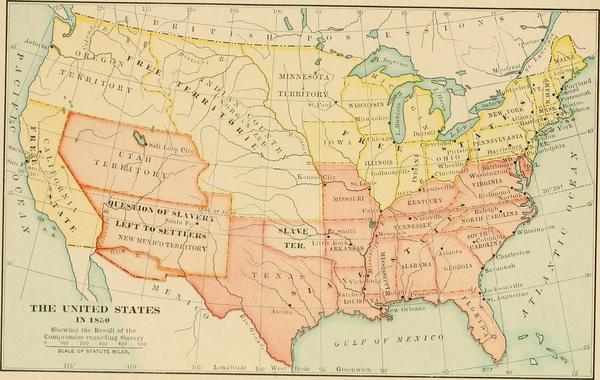
The Compromise of 1850 was a series of bills intended to appease the pro-slavery and anti-slavery factions within the American population that had been inflamed as a result of the newly acquired territories that came from the Mexican-American War.
The acts organized the new territory as the Utah and New Mexico territory, and it also admitted California, which had already been heavily populated 1848, to the union as a free state. The Compromise of 1850 also established the concept of popular sovereignty, which meant that new states would vote on the issue of slavery before being admitted to the union.
This postponed the tensions at the time, but they would come back just two years later when Stephen Douglas attempted to organize the Kansas and Nebraska territories for statehood and eventually passed the Kansas-Nebraska Act, which allowed popular soveriegnty to determine the fate of slavery in these new lands.
Recognizing the implications on a national scale, both sides sent people to vote illegally in these territories about the slavery question, which led to a conflict known as Bleeding Kansas. This conflict lasted throughout the 1950s and was a major precursor to the US Civil War.
READ MORE: John D. Rockefeller
Civil War (1860-1865)
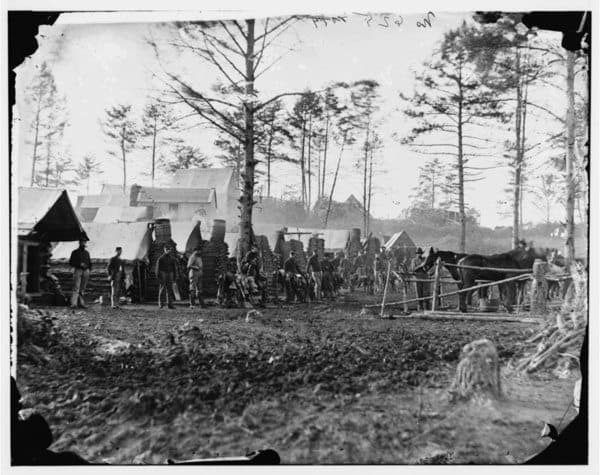
By the end of the 1850s, the issue of slavery continued to define national discourse. Northern states generally opposed it since slave labor kept wages down and limited industrial growth, whereas Southern states felt abolishing slavery would cripple their economies and leave them helpless to the whims of the Federal government. Secession had been mentioned before, but it was pursued with vigor after the 1860 election which saw Abraham Lincoln elected without appearing on the ballot in a single southern state. This signaled to the South that they had lost all say in the Federal government and that their autonomy would never be respected.
As a result, in 1861, South Carolina declared it would secede from the union, and it was soon followed by six others: Louisiana, Mississippi, Georgia, Alabama, Florida, and Texas. President Lincoln attempted to avoid conflict by withholding military action, but he rejected a peace treaty offered by the south on the grounds that negotiation would recognize the South as an independent nation. This led the seceded states to take up arms, which they did by bombarding Fort Sumter in Charleston, South Carolina. Their victory rallied support for the union, but several other southern states, specifically North Carolina, Arkansas, Virginia, and Tennessee, refused to send troops, and after the battle, they too claimed to secede from the United States. Maryland attempted to secede, but fearing this would leave the nation’s capital surrounded by insurgents, Lincoln imposed Martial Law and prevent Maryland from joining the Union.
The seceded states formed the Confederate States of America and placed their capital in Richmond, Virginia. Jefferson Davis was elected as president, although he was never recognized by the United States. Lincoln’s government never acknowledged the Confederacy, choosing to deal with it as an insurrection.
Generally speaking, it was easy for both sides to raise an army. Supporters of the Union were motivated by national pride and a desire to keep the Union intact, whereas Southerners were motivated by the fear of losing their slavery-defined existence. But things were not nearly as black and white, particularly in the border states where sentiments were mixed. In these states, people fought for both sides. In fact, in Tennessee, which technically seceded, more people fought for the Union side than the Confederate, showing us just how complex this issue really was.
The Eastern Theater
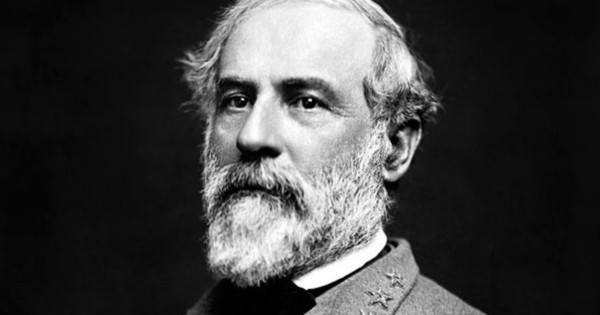
Seeking to show to the Union the power and strength of the north, and hoping to convince Lincoln and the Unionists to abandon conflict and seek peace, the Confederate army in the east, organized as the Army of Northern Virginia under General Robert E. Lee, sought to defend the territories in Northern Virginia and then advance into Union-controlled territories. Together with Stonewall Jackson, Lee and his army won several victories at the Battle of Bull Run, the Battle of the Shenandoah, and then the Second Battle of Bull Run. Lee then decided to invade Maryland, where he engaged the Northern Army at the Battle of Antietam. This was the bloodiest battle in the entire Civil War, but it ended in a Union victory. However, Union general George MacClellan, who was often criticized by Lincoln for being too lenient towards his Southern enemies, did not pursue Lee’s army, leaving it intact and setting the stage for more fighting.
MacClellan was then replaced by General Ambrose Burnside, who was defeated at the Battle of Fredericksburg and then replaced by General Thomas Hooker. Hooker lost the Battle of Chancellorsville, and he was fired by Lincoln and replaced by General George Meade, who would lead the Union army in the Battle of Gettysburg.
The Battle of Gettysburg took place on July 1,2, and 3, 1862, the last day of which was marked by the disastrous Pickett’s Charge. Lee’s army was defeated and forced to retreat, but Meade did not pursue, a move that infuriated Lincoln for the same reasons he was angered at McClellan. However, Lee’s army would never recover from the losses it suffered at Gettysburg, which all but brought the Eastern Theater of the Civil War to a Close.
The Western Theater
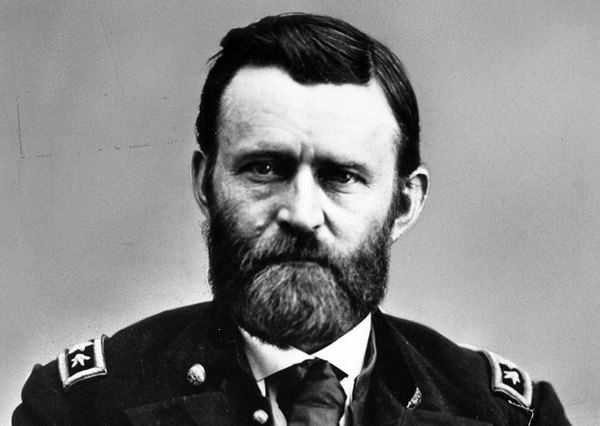
In contrast to the Eastern Theater, the Union was repeatedly successful in the Western Theater under the leadership of General Ulysses S. Grant and his Army of the Cumberbund and Army of Tennessee. Grant managed to win several key victories at Memphis and Vicksburg, among many others, and he showed a willingness to demonstrate no mercy to retreating Confederate troops, a character trait that quickly put him in Lincoln’s good graces. Grants success in the West meant that by 1863, the Union had managed to take control of all territories West of the Mississippi. Because of this, Lincoln made Grant the commander of all Union armies in 1863.
The year 1863 is also important because it marks the issuance of the Emancipation Proclamation, which freed slaves in the states currently under rebellion. This encouraged slaves in the South to flee and to take up arms against their oppressors, a move which not only bolstered the Union army but also crippled the Southern economy and war machine. This laid the groundwork for the abolition of slavery, but it’s always important to remember that Lincoln was not an abolitionist. He enacted this policy as a way to win the war, and he knew that, as a presidential decree, it would not hold up in any court once the war was over. But even so, this decision had a tremendous impact on the war and the future of the United States.
Throughout 1863, the Union managed to win several victories throughout the South, as well as in the Trans-Mississippi region and California, making the prospects of Southern victory even dimmer. This also set the stage for the final year of the way, which would lead to the end of the Civil War. Lincoln faced reelection in 1864 and was challenged by fellow Republican and former general George MacClellan, who ran a campaign on peace and reconciliation. However, Lincoln managed to beat MacClellan and the war continued.
Winning the War
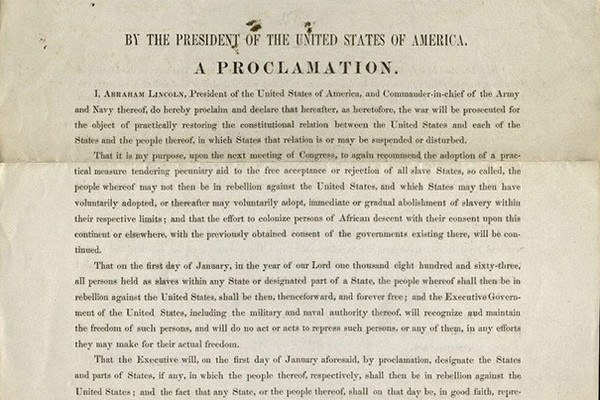
In 1864, Lincoln could smell victory. His blockade in the South, the Emancipation Proclamation, and his new generals, finally gave him the ingredients he needed to choke out the south and end the rebellion, and in 1863, he gave a series of orders that would eventually bring the war to a close.
The first was to send Grant and the Army of the Potomac into Northern Virginia to seize the Confederate capital of Richmond. However, Lee’s Army of Northern Virginia was still strong, and they managed to force this part of the war into a stalemate.
After this, Lincoln sent General Phillip Sheridan into the Shenandoah Valley to destroy farmland and engage the Confederate armies. He managed to win a series of victories, including a decisive one at the Battle of Cedar Creek, and he left the Shenandoah Valley crippled, which would have put Virginia and the rest of the south in a truly dire situation. This campaign also gave Lincoln the recipe for success, which he employed in the heart of Dixie to win the war.
This move became known as “Sherman’s March to the Sea.” It started in Atlanta, which had been left open thanks to Grant’s victories in the West, and Lincoln sent an army under the command of General William Tecumseh Sherman. He was then instructed to make his way to the sea, but he was given no final destination. So, as he made his way east, he and his armies began pillaging Southern farmland. Slaves began fleeing to his army, and civilians were also forced to abandon. This total war tactic crippled the south even more and left their rebellion in shambles.
Lincoln was inaugurated to a second term on March 4, 1865, and it was clear the war was almost over. His inauguration speech, known as Lincoln’s Second Inaugural Address, is one of the more famous presidential speeches ever given, and it set a tone of reconciliation, not retribution, for his second term.
The Confederacy attempted a comeback at the Battle of Five Forks, but they were defeated, forcing Lee to retreat with his Army of Northern Virginia. Eventually, and reluctantly, he surrendered at Appomattox Courthouse, where his army was surrounded, effectively bringing an end to the Civil War. However, the hard work was just about to begin as the nation sought to repair the wounds of four years of intense warfare. But President Lincoln would be unable to oversee this transition. He was shot by John Wilkes Booth at Ford’s Theater on April 14, 1865, just five days after the end of the war, making Andrew Johnson the president and the caretaker of what we now call the Reconstruction Period.
Reconstruction (1865-1877)
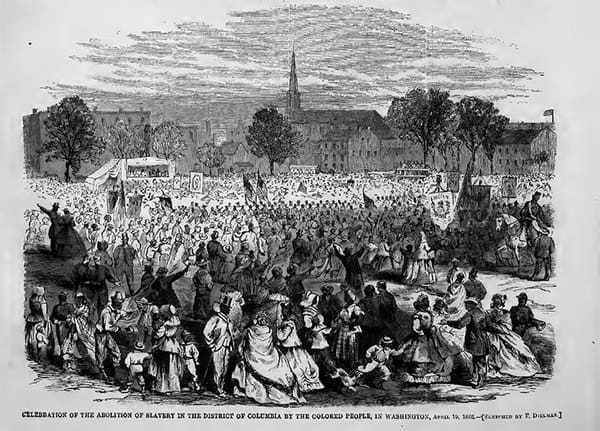
The era immediately succeeding the Civil War is known as the Reconstruction Era, as it was defined by attempts to repair the wounds of war and bring the South back into the Union. Slavery was outlawed by the passage of the 13th Amendment, and blacks were given new rights and political representation from the 14th and 15th Amendments.
However, the United States was still very much a racist country, and few people truly intended to grant blacks the same rights as whites. This led to policies and practices that effectively continued the institution of slavery under a different name. Furthermore, policies of segregation were passed throughout the South, which later became known as Jim Crow laws, that subjugated blacks and kept them as second class citizens. Many of these laws remained intact until the 1960s, and they created a vast gap between whites and blacks in the south that still exists to this day.
Because of this, many historians consider American attempts at Reconstruction to be failures. This happened largely due to the wide range of opinions about how to reconstruct, with many prominent Americans preferring a more lenient approach so as to prevent further conflict. However, this gave the South more freedom and it protected many of the political institutions that were founded on racist ideals. During this period, the South also fought to reshape public opinion about the war, working to frame it as an issue of state’s rights and not slavery. This approach clearly worked, as many Americans today are still unsure about the fact that the main cause of the Civil War was the issue of slavery.
READ MORE: Compromise of 1877
Industrial/Gilded Age (1877-1890)
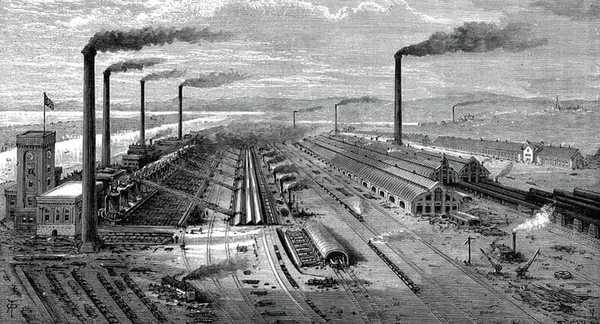
After Reconstruction, the United States entered a period of unprecedented economic growth fueled by industrialization. Much of this growth took place in the North and the West where there was already a strong industrial base, and it drove a rapid increase in wages that attracted immigrants from Europe, which had become much poorer in comparison to the United States.
Much of this growth was fueled by the expansion of the railroad systems, which was extended all the way to the Pacific Ocean. Engineering schools were established all over the country with the aim of accelerating the mechanization of American industry, and oil quickly became a precious commodity. Banking and finance also grew considerably during this age, and it was during this era that we begin to see names such as Cornelius Vanderbilt, John Rockefeller, JP Morgan, Andrew Carnegie, et al, who all amassed massive fortunes from America’s industrialization and economic growth.
READ MORE: Who Invented the Railroad? Exploring the Fascinating History of Railroads
Progressive Era (1890-1920)
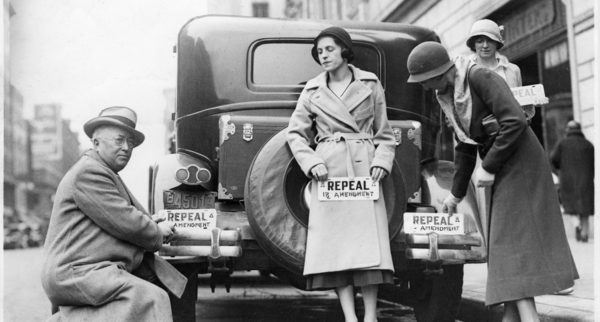
The Gilded Age was followed up by what is known as the Progressive Era, which was a period in time defined by efforts to “fix” the problems created by America’s rapid industrialization. It focused on reducing the power of big corporations and the wealthy elite. Antitrust laws were established during this time, many of which still hold until this day.
The movement also extended further out into society. People all across the country sought to improve education, health, and finance, and the Women’s Suffrage movement also took off. The Temperance Movement, which brought on a nationwide ban of alcohol, also known as Prohibition, also has its roots in the Progressive Era.
World War 1 (1914-1918)
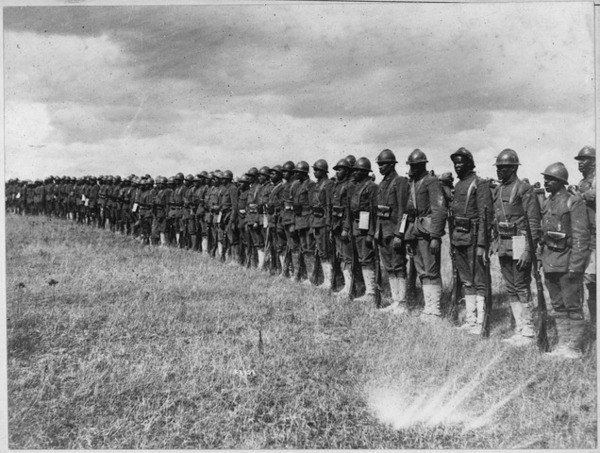
Before 1914, the United States, although getting richer and more powerful by the day, had managed to avoid getting involved in international conflicts. However, this changed in 1917 when the US declared war on Germany and joined the conflict we now know as World War I.
In the years before issuing a formal declaration of war, the US contributed supplies and money to the British, but they did not send troops until after 1917. During this period, President Woodrow Wilson had to take significant steps, ones that had not previously been under the umbrella of presidential powers, to mobilize the nation’s war machine, but these led to a period of unprecedented economic growth.
In total, the US contributed around 4 million troops to the war effort, and some 118,000 people died. This marked an important transition in American history as the United States would become increasingly involved in the affairs of Europe.
Roaring Twenties (1920-1929)
After World War I, nearly all of Western Europe and the United States entered a period of prosperity known now as the Roaring Twenties. This period was defined by widespread growth in technologies such as the automobile and moving pictures, and jazz music and dancing became more mainstream.
READ MORE: Harmonizing History: Who Invented Jazz?
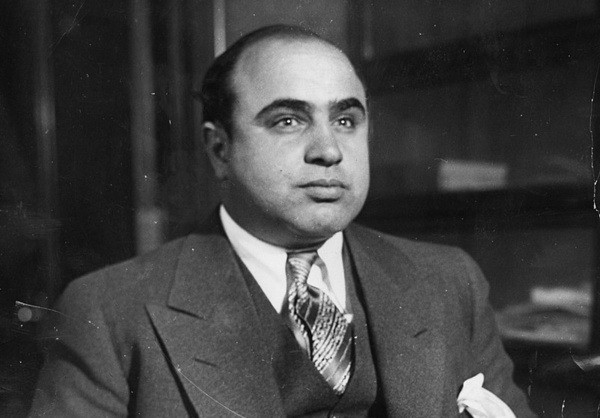
The Roaring Twenties also gave birth to the “Flapper girl,” which dramatically changed the image of women in both the US and Britain. In the United States, due to the ban on alcohol, organized crime also grew, with gangsters such as Al Capone rising to prominence. This period of prosperity continued all the way up until the stock market crash of 1929, which plummeted the world into an economic depression.
US History Trivia
Despite continuously occupying the North American continent for at least 15,000 years, Native Americans weren’t classified as American citizens until 1924 when congress passed the Indian Citizenship Act.
Great Depression (1929-1941)
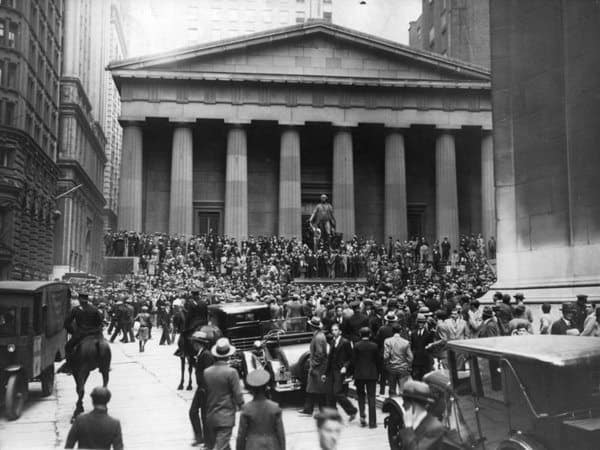
The boom of the Roaring Twenties was all but eliminated between October 24 and October 25, 1929, as the stock market crash and people ran on the banks, wiping out fortunes both big and small all around the world. The global economy came to a halt, and things were no different in the United States where people lost their jobs and began experiencing food shortages.
Herbert Hoover lost to Franklin Delano Roosevelt in the 1932 election, and Roosevelt began to implement his New Deal policies, which involved massive government expenditure designed to stimulate the economy, a theory that is based on Keynesian economics. These policies did not actually change the economic situation in America, but they did reshape the public’s opinion on government’s role in society. These policies also got rid of the Gold Standard, which gave the Federal government and Federal Reserve more control over the nation’s monetary supply.
Roosevelt’s New Deal did increase GDP during the 1930s and greatly improved infrastructure, but it did not on its own end the depression. For this to happen, unfortunately, the United States would once again need to enter the fray of international conflict and fight alongside the Allies in World War II.
World War II (1941-1945)
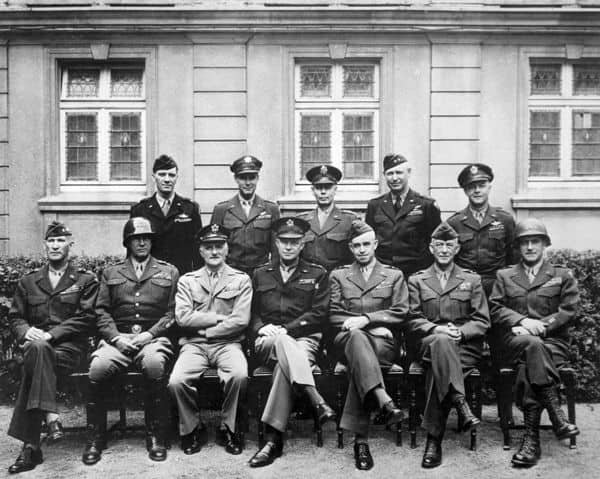
The US joined World War II on December 7, 1941 by declaring war in Japan after Japanese warships bombed Pearl Harbor. The US then entered the European theater a few days later when it declared war on Germany on December 11, 1941. These two declarations meant that the United States, for the first time ever, would need to fight in two very distinct theaters. This led to a massive war mobilization effort the likes of which has never been seen before. The might of American industry was in full view, and widespread nationalism lent support for the war. Everyone did their part, which meant many women went to work in factories.
READ MORE: World War II timeline and dates
North Africa and European Theaters
Under the leadership of General George S. Patton, the Americans entered the war against Germany in 1942 when they launched Operation Torch in North Africa, specifically in Morrocco and Tunisia. Here, Patton managed to push back Erwin Rommels and his armies of tanks, forcing the Germans to retreat back into Europe.
The US and its allies then invaded Sicily and Italy in early 1943, which prompted a coup in Rome that saw the overthrow of dictator Benito Mussolini, but Italians loyal to the fascist cause continued to fight until 1944 when Rome was liberated. The Allies attempted to advance through northern Italy, but the harsh terrain made it impossible, and with the impending invasion of France, the Allies began to redirect their resources elsewhere.
The Allies, led by the Americans but supported by the British and Canadians, invaded France on June 6, 1944 at Normandy, France. From there, the Allied forces made their way into Belgium and the Netherlands before invading Germany. The Soviets made progress on the Eastern front as well, and they entered Berlin on April 15, 1945. This led to Germany’s unconditional surrender on May 8, 1945, and the American led Allied forces, which by now had been uncovering and liberating Nazi concentration camps, entered Berlin on July 4, 1945.
The Pacific Theater
The US fought the Japanese in the Pacific using amphibious warfare tactics, which gave rise to the Marines as an important part of the American military. The US Navy also played an important role in winning important battles throughout the Pacific, such as the Battle of Midway, Battle of Guadalcanal, the Battle of the Okinawa and the Battle of Iwo Jima.
The harsh terrain of the Pacific islands combined with the no-surrender tactics of Japanese soldiers made progress in the Pacific Theater both slow and costly. The US eventually reverted to total war tactics, which culminated with the complete destruction of Tokyo as well as the use of nuclear weapons on the Japanese cities of Hiroshima and Nagasaki. The Japanese surrendered shortly after these bombings in August of 1945, but there is considerable evidence to suggest it was actually the entrance of the Soviets into the Pacific Theater that led Japanese leadership to abandon the war. With Japan’s unconditional surrender, World War II had officially ended, but not after dramatically reshaping world and US history.
Post War Boom (1946-1959)
Due to the massive mobilization of the American economy during the war, as well as the growth in population brought on by the Baby Boom, and support packages for veterans such as the GI Bill, post-War America was growing faster than it ever had before. Plus, with most of Europe destroyed, the United States found itself in a unique position where its goods were in demand all over the world. This caused a massive expansion in American wealth, which, along with its military success in the war, placed it on top of the world alongside the Soviet Union. This period turned America into a superpower, and it also brought on a cultural revolution as American society was younger and wealthier than it had ever been before.
Civil Rights Movement (1948-1965)
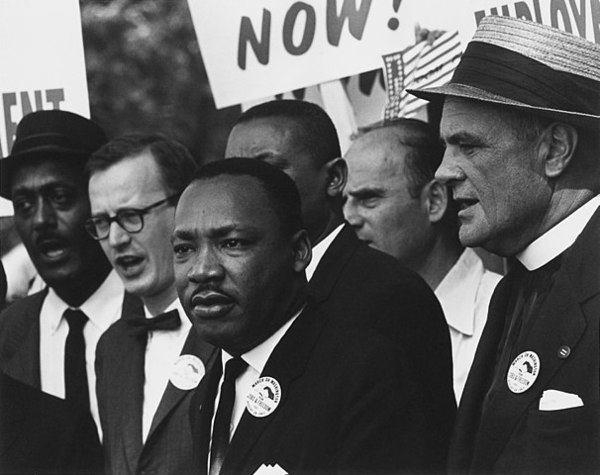
Shortly after the war, black Americans began mobilizing and demanding the equal rights they were promised by the Constitution and the 13th, 14th, and 15th amendments. They organized peaceful mass protests such as boycotts and sit-ins, often sparked by unwitting participants (such as Ruby Bridges) to pressure governments, especially those in the south, to abolish Jim Crow Laws and guarantee basic equal rights. The Reverend Dr. Martin Luther King, Jr. became the leader of a national Civil Rights Movement, which was also supported by more radical leaders such as Malcolm X. After nearly 20 years of protests, black Americans succeeded in their goal with the passage of the Civil Rights Act of 1964 by the Kennedy Administration. However, as we know, blacks still face considerable disadvantages in today’s America, and, sadly, the fight for true equality is far from over.
Cold War (1945-1991)
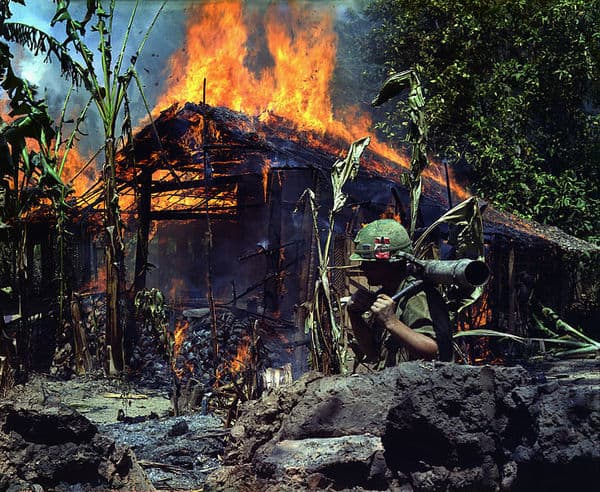
With most of Europe in shambles after World War II, the United States and Russia emerged as the world’s two superpowers. Both had nuclear weapons, and the United State had shown a willingness to use them in war. However, ideologically, the two countries were radically different. The United States, which had a democratic government and capitalist economy was in stark contrast to the communist dictatorships that defined the Soviet Union. However, despite what it became, communism was a popular ideology throughout the world, especially in the former European colonies in Asia and Africa, many of which gained independence in the fallout of World War II.
Seeking to expand its power, the Soviet Union began lending support to countries where communist governments were emerging, but the United States, fearing a more powerful and influential Soviet Union, sought to block this expansion, which often meant supporting those who stood in opposition to communist governments.
Politicians in the United States propagated the Domino Effect Theory, which stated that allowing one country, especially in Southeast Asia which was surrounded by communist China and Russia, to fall to communism, would lead to a global takeover of this oppressive form of government. The validity of this theory has been called into question time and time again, but it was the main justification for increased military conflict after World War II in areas of the world where Russia was attempting to exert its influence.
This policy led to a series of proxy wars between the US and Russia which we now know as the Cold War. The US and Russia never fought directly, but many of the wars of independence fought in the lands of former European colonies, became ideological struggles between the United States and the Soviet Union.
The two most prominent of these proxy wars were the Korean War, which ended with the partition of Korea into Communist North Korea and the Republic of South Korea, as well as the Vietnam War, which ended in the Fall of Saigon and the unification of Vietnam under a communist government. However, this fighting took place in other areas of the world, such as in Afghanistan and Angola, and the threat of nuclear war between the United State and Russia loomed over both populations throughout the 1960s and 1970s.
However, by the 1980s, the inefficiency of the communist system, as well as corruption within its governments, marked the beginning of the end of the Soviet Union, and the US, which continued to grow, established itself as the world’s one and only superpower.
Reagan to the Present
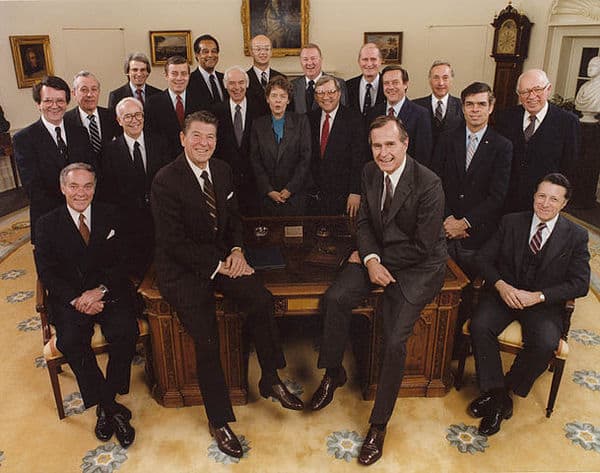
Ronald Regan took over as president on January 20, 1981 at a time when the United States was suffering a decline. The Vietnam War had torn the country apart throughout the 1960s and much of the 1970s, unemployment was up, crime was up, and inflation was making life difficult for millions of Americans. His response was to take a tough stance on crime, launching the controversial “War on Drugs,” which many critics today argue is and was a mechanism of further oppressing underprivileged blacks. He also reformed the tax code to reduce the individual tax burden of millions of people.
However, Reagan was also a champion of “trickle-down economics,” a philosophy that states that cutting taxes for the wealthy and removing barriers to industry will cause wealth to trickle down from the top. This approach led to unprecedented deregulation in the American finance system, which many argue contributed to the practices that led to the Great Recession of 2008. Reagan also oversaw the culmination of the Cold War. He supported anti-Communist movements throughout Central America and Africa, and shortly after he left office, the Berlin Wall fell, which effectively dissolved the Soviet Union.
Despite the controversy surrounding Reagan, he left office when the economy was booming. His successor, Bill Clinton, oversaw continued growth and even managed to balance the federal budget, something that has not been done since. However, Clinton’s presidency ended in scandal with the Monica Lewinsky issue, and this has diminished the significance of some of his achievements.
The 2000 presidential election turned out to be a turning point in American history. Al Gore, Clinton’s Vice President, won the popular vote, but counting issues in Florida left the Electoral College vote undecided until the Supreme Court ordered election officials to stop counting, a move that handed Gore’s opponent, George W. Bush, the presidency. Just a year later came the 9/11 attacks, which once again sprung the American war machine into action. The Bush administration invaded both Iraq and Afghanistan, claiming Iraq had terrorist ties and that dictator Saddam Hussein had weapons of mass destruction. This proved to be false, and the removal of Hussein’s government destabilize the region. America remains engaged in Middle Eastern conflicts to this day, although many theorize this has to do with special interests, such as oil.
The Future of the United States
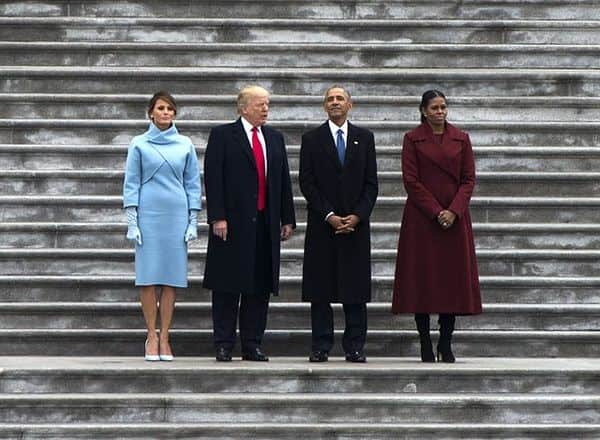
In 2008, the United States made history by electing Barack Obama, the nation’s first black president. Obama rose to power with promises of change, but a right-wing populist movement, known as the Tea Party Caucus, took control of the House and Senate in 2010, stunting his ability to make progress, despite his reelection in 2012. The success of the Tea Party, though, was not short-lived, as in 2018, Donald Trump, catering mostly to non-college educated white people of the Rust and Bible Belts, managed to win the presidency.
Trump has ushered in an America First policy that opposes international trade, immigration, and international cooperation, strategies that have for the first time since World War II called into question America’s role as the world’s leader and superpower. For the time being, the US still has the world’s largest economy and the dollar remains supreme, but internal divisions, as well as swelling economic inequality, are exposing some of the country’s domestic issues, and only time will tell how this will shape the nation’s, and the world’s, history.
Reader beware… lots of bias and opinions interjected throughout masquerading as historical fact.